"My time, just the moment between the pillow and sleep,
Vacations spent working elsewhere,
When I could be sleeping,
Sitting is a luxury, only dreams are my refuge"
Holy Moses, I have been removed, I have seen the spectre, he has been here too, Distant cousin from down the line Brand of people who ain't my kind Holy Moses, I have been removed
Holy Moses, I have been deceived, Now the wind has changed direction and I'll have to leave Won't you please excuse my frankness but it's not my cup of tea Holy Moses, I have been deceived
I'm going back to the border Where my affairs, my affairs ain't abused I can't take any more bad water I've been poisoned from my head down to my shoes
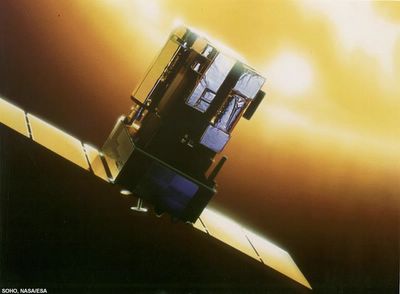
SOHO was launched on December 2, 1995. The SOHO spacecraft was built in Europe by an industry team led by Matra, and instruments were provided by European and American scientists. There are nine European Principal Investigators (PI's) and three American ones. Large engineering teams and more than 200 co-investigators from many institutions supported the PI's in the development of the instruments and in the preparation of their operations and data analysis. NASA was responsible for the launch and is now responsible for mission operations. Large radio dishes around the world which form NASA's Deep Space Network are used to track the spacecraft beyond the Earth's orbit. Mission control is based at Goddard Space Flight Center in Maryland.
Originally a two-year mission, SOHO has now operated for over ten years (as of 2006). It has proved so useful that a follow-on mission, the Solar Dynamics Observatory, is planned for launch in 2008. Situated at the Lagrangian point between the Earth and the Sun (at which the gravitational pull from both is equal), SOHO has provided a constant view of the Sun at many wavelengths since its launch. In addition to its direct solar observation, SOHO has enabled the discovery of large numbers of comets, mostly very tiny sungrazing comets which incinerate as they pass the Sun.
Humanity's most fundamental understanding of the Sun is as the luminous disk in the heavens, whose presence above the horizon creates day and whose absence causes night. In many prehistoric and ancient cultures, the Sun was thought to be a solar deity or other supernatural phenomenon, and worship of the Sun was central to civilizations such as the Inca of South America and the Aztecs of what is now Mexico.
Many ancient monuments were constructed with solar phenomena in mind; for example, stone megaliths accurately mark the summer solstice (some of the most prominent megaliths are located in Nabta Playa, Egypt, and at Stonehenge in England); the pyramid of El Castillo at Chichén Itzá in Mexico is designed to cast shadows in the shape of serpents climbing the pyramid at the vernal and autumn equinoxes.
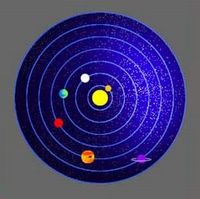
With respect to the fixed stars, the Sun appears from Earth to revolve once a year along the ecliptic through the zodiac, and so the Sun was considered by Greek astronomers to be one of the seven planets (Greek planetes, "wanderer"), after which the seven days of the week are named in some languages.
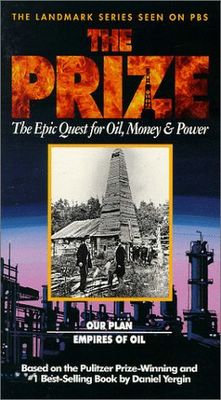
The Prize: The Epic Quest for Oil, Money, and Power (1991; ISBN 0671502484) is Daniel Yergin's 800-page history of the global oil industry from the 1850s through 1990. The Prize benefited from extraordinary timing: published in October 1990, two months after the invasion of Kuwait ordered by Saddam Hussein and three months before the U.S.-led coalition unleashed the Gulf War to oust Iraqi troops from that country, the book's theme of the historical centrality of what its subtitle calls "the epic quest for oil, money, and power" was in tune with the zeitgeist; the book became a number-one bestseller in the United States and won a Pulitzer Prize.
Part III: War and Strategy
Ch. 16: Japan’s Road to War
Japan occupies Manchuria, 1931 (305). Ultranationalist militarists in power (306). Japan dependent on foreign oil, especially Rising Sun (Japanese affiliate of Royal Dutch/Shell) and Standard-Vacuum (Stanvac, an amalgam of Jersey and Standard of New York’s Far East operations) (307). 1934 Petroleum Industry Law squeezed companies (308). Japan attacks China, 1937; placates companies as U.S. public opinion sides with China (308-10). Stanvac resolved on embargo of Japan if U.S. so decides (310-11). U.S. moves fleet to Pearl Harbor and restricts (but does not stop) oil shipments to Japan, 1940 (311-13). Cordell Hull & Admiral Nomura converse repeatedly (313-14). Admiral Yamamoto sensitive to Japan’s oil predicament (314-16). Japan invades Indochina; U.S. effectively embargoes oil, July 1941 (316-19). P.M. Konoye-Roosevelt summit doesn’t come off (319-20). Japanese resolve on war (320-23). Operation Hawaii’s primary target is East Indian oilfields (325-26). Japanese err in failing to destroy 4,500,000 barrels (720,000 m³) of vulnerable U.S. oil supplies at Pearl Harbor (326-27).
The Documentary Film
Amazon.com
The PBS documentary film is an exciting and entertaining eight-part series, based on Daniel Yergin's Pulitzer Prize-winning book, captures the panoramic history of the biggest industry in the world. Shot on location in Azerbaijan, Egypt, England, Indonesia, Japan, Kuwait, Mexico, Russia, Scotland, Turkey, and the United States, the series features fascinating characters, archival footage, and interviews with the people who shaped the oil industry.
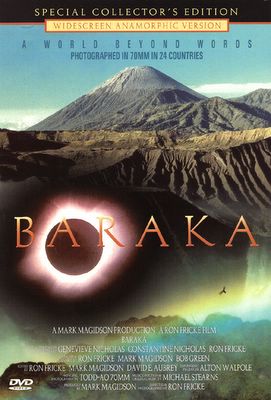
Baraka is an incredible journey through 6 continents, 24 countries. Painstakingly shot on Todd AO-70mm film. Baraka has no plot, contains no actors and has no script. Baraka is a collection of high quality images, presented in a moving and compelling manner.
Baraka is evidence of a huge global project fueled by a personal passion for the world and visual art. Working on a reported US$4 million budget, Ron Fricke and Mark Magidson, with a three-person crew, swept through 24 countries in 14 months to make this stunning film. One of the very last films shot in the expensive TODD-AO 70mm format, Ron Fricke developed a computer-controlled camera for the incredible time-lapse shots, including New York's Park Avenue rush hour traffic and the crowded Tokyo subway platforms.
"Noam Chomsky, professor of linguistics at the Massachusetts Institute of Technology and one of the foremost critics of U.S. foreign policy. Professor Chomsky has just released a new book titled "Failed States: The Abuse of Power and the Assault on Democracy."
It examines how the United States is beginning to resemble a failed state that cannot protect its citizens from violence and has a government that regards itself as beyond the reach of domestic or international law.
In the book, Professor Noam Chomsky presents a series of solutions to help rescue the nation from turning into a failed state."
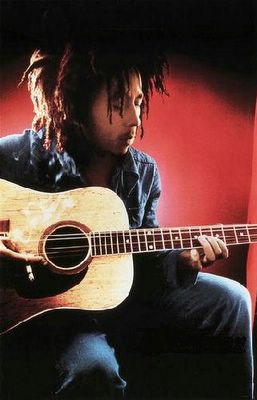
Man to man is so unjust, children
You don't know who to trust
Your worst enemy could be your best friend
And your best friend your worst enemy
Some will eat and drink with you
Then behind them su-su 'pon you
Only your friend know your secrets
So only he could reveal it
Some will hate you, pretend they love you now,
Then behind they try to eliminate you.
But who Jah bless, no one curse;
Thank God, we're past the worse.
Hypocrites and parasites
Will come up and take a bite.
And if your night should turn to day,
A lot of people would run away.
A Short History of Nearly Everything
Bill Bryson
In A Short History of Nearly Everything, beloved author Bill Bryson confronts his greatest challenge yet: to understand—and, if possible, answer—the oldest, biggest questions we have posed about the universe and ourselves. Taking as his territory everything from the Big Bang to the rise of civilization, Bryson seeks to understand how we got from there being nothing at all to there being us.
“Stylish [and] stunningly accurate prose. We learn what the material world is like from the smallest quark to the largest galaxy and at all the levels in between . . . brims with strange and amazing facts . . . destined to become a modern classic of science writing.”
A handful of genes that control the body's defenses during hard times can also dramatically improve health and prolong life in diverse organisms. Understanding how they work may reveal the keys to extending human life span while banishing diseases of old age.
sciam.com - Scientific American Magazine March 2006
"Take a coveted commercial location in Tokyo, and Tadao Ando, one of Japan's most talented architects, and what do you get? A building that is now dubbed “Omotesando Hills”. From the outside, the two-story structure, covered in 250 square metres of glass, offers no hint of what lies within. But step inside and you find yourself in a long, narrow building, with sloping walkways and more than 90 spanking new shops and restaurants. On the upper floors are 38 smart flats."
Fresh Air from WHYY
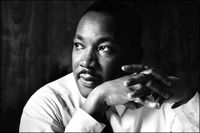
Terry Gross talks with author Taylor Branch, who has written the third in a trilogy of biographies on Martin Luther King Jr.
January 16, 2006
The first book of a formidable three-volume social history, Parting the Waters is more than just a biography of the Rev. Martin Luther King Jr. during the decade preceding his emergence as a national figure. Branch's thousand-page effort, which won the Pulitzer Prize as well as the National Book Critics Circle Award for General Nonfiction, profiles the key players and events that helped shape the American social landscape following World War II but before the civil-rights movement of the 1960s reached its climax. The author then goes a step further, endeavoring to explain how the struggles evolved as they did by probing the influences of the main actors while discussing the manner in which events conspired to create fertile ground for change.
Pillar of Fire is the second volume of Taylor Branch's magisterial three-volume history of America during the life of the Reverend Martin Luther King Jr. Branch's thesis, as he explains in the introduction, is that "King's life is the best and most important metaphor for American history in the watershed postwar years," but this is not just a biography. Instead it is a work of history, with King at its focal point. The tumultuous years that Branch covers saw the assassination of President John F. Kennedy, the beginnings of American disillusionment with the war in Vietnam, and, of course, the civil rights movement that King led, a movement that transformed America as the nation finally tried to live up to the ideals on which it was founded.
King's movement may have been nonviolent, but his times were not, and each of Branch's volumes ends with an assassination: JFK, then Malcolm X, and finally King's murder in Memphis. We know that's where At Canaan's Gate is headed, but it starts with King's last great national success, the marches for voting rights in Selma, Alabama, in 1965. Once again, the violent response to nonviolent protest brought national attention and support to King's cause, and within months his sometime ally Lyndon Johnson was able to push through the Voting Rights Act. But alongside those events, forces were gathering that would pull King's movement apart and threaten his national leadership. The day after Selma's "Bloody Sunday," the first U.S. combat troops arrived in South Vietnam, while five days after the signing of the Voting Rights Act, the Watts riots began in Los Angeles. As the escalating carnage in Vietnam and the frustrating pace of reform at home drove many in the movement, most notably Stokely Carmichael, away from nonviolence, King kept to his most cherished principle and followed where its logic took him: to war protests that broke his alliance with Johnson and to a widening battle against poverty in the North as well as the South that caused both critics and allies to declare his movement unfocused and irrelevant.
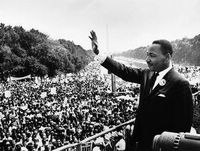
"After contemplation, I conclude that this award which I receive on behalf of that movement is a profound recognition that nonviolence is the answer to the crucial political and moral question of our time - - the need for man to overcome oppression and violence without resorting to violence and oppression. Civilization and violence are antithetical concepts.
Negroes of the United States, following the people of India, have demonstrated that nonviolence is not sterile passivity, but a powerful moral force which makes for social transformation. Sooner or later all the people of the world will have to discover a way to live together in peace, and thereby transform this pending cosmic elegy into a creative psalm of brotherhood, If this is to be achieved, man must evolve for all human conflict a method which rejects revenge, aggression and retaliation. The foundation of such a method is love."
The Martin Luther King, Jr. National Historic Siteconsists of several buildings surrounding Martin Luther King, Jr.'s boyhood home on Auburn Avenue in the Sweet Auburn district of Atlanta, Georgia. Ebenezer Baptist Church, the church where King and his father Martin Luther King, Sr. pastored, is also part of the National Historic Site. Although the Baptist congregation moved to a new sactuary across the street, the historic church is used occasionally for services and special events.
The area was designated a National Historic Landmark district on May 5, 1977. The site became a National Historic Site on October 10, 1980 and is administered by the National Park Service. In total, the buildings included in the park make up 39 acres (158,000 m²). The visitor's center contains a museum that chronicles the American Civil Rights Movement and King's role in the movement. Fire Station No. 6, a firehouse built in 1894, contains a gift shop and an exhibit on desegregation in the Atlanta Fire Department.
The King Center is the official, living memorial dedicated to the advancement of the legacy of Dr. Martin Luther King, Jr., leader of America’s greatest nonviolent movement for justice, equality and peace.
The King Center Develops and disseminates programs that educate the world about Dr. King’s philosophy and methods of nonviolence, human relations, service to mankind, and related teachings.
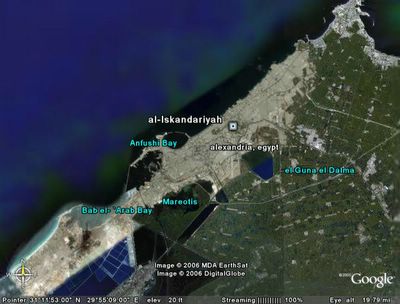
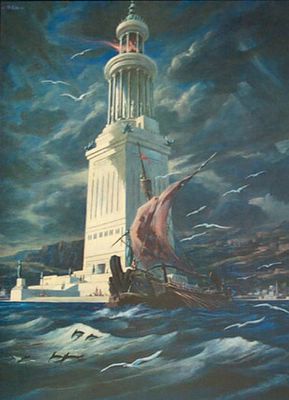
The city of Alexandria, Egypt was named after its founder, Alexander the Great, and was the seat of the Ptolemaic rulers of Egypt. It quickly became one of the greatest cities of the Hellenistic world second only to Rome in size and wealth throughout much of antiquity.
In ancient times, Alexandria was known for its lighthouse (one of the Seven Wonders of the World) and the Library of Alexandria (the largest library in the world).
Its tower is estimated to have been 134 m (440 ft) high, easily one of the tallest man-made structures on Earth at the time. Built out of blocks of white stone, the tower was made up of three stages: a lower square with a central core, a middle octagonal section, and, at the top, a circular section. At its apex was positioned a mirror which reflected sunlight during the day; a fire was lit at night.
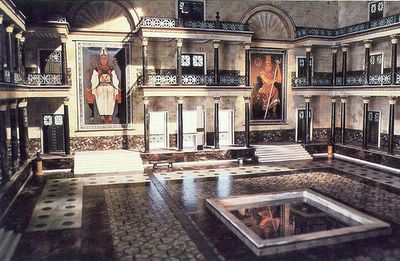
The Royal Library of Alexandria in Alexandria, Egypt was once the largest library in the world. It is generally assumed to have been founded at the beginning of the 3rd century BC, during the reign of Ptolemy II of Egypt, after Ptolemy's father had raised what would become the first part of the library complex, the temple of the Muses, the Musaeum (where we get the museum from).
At its peak, the Royal Library is believed to have held anywhere between 40,000 to 700,000 books and was initially organized by Demetrius Phalereus. It has been reasonably established that the library was destroyed by fire yet, to this day, the details of the destruction or destructions remain a lively source of controversy.
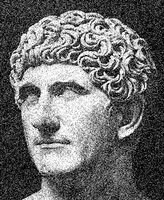
Mark Antony
Marcus Antonius (ca. 83 - 30 BC), known in English as Mark Antony, was a Roman politician and general. He was an important supporter of Julius Caesar as a military commander and administrator. After Caesar's assassination, Antony allied with Octavian and Marcus Aemilius Lepidus to form the second triumvirate. The triumvirate broke up in 33 BC and the disagreement turned to civil war in 31 BC, in which Antony was defeated by Octavian ttle of Actium and then at Alexandria.
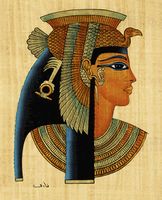
Cleopatra
Cleopatra VII (69 - 30 BC) was queen of ancient Egypt, the last member of the Ptolemaic dynasty and hence the last Hellenistic ruler of Egypt. Although many other Egyptian Queens shared the name, she is usually known as simply Cleopatra, and all of her similarly named predecessors have been mostly forgotten.
WGBH is an established public television and public radio broadcast service located in Boston, Massachusetts. It operates over ten broadcasts: primarily WGBH 2 and WGBX 44 (television) and WGBH 89.7 FM (radio). WGBH is a member of PBS in regard to its television broadcasts, and both a member of NPR and an affiliate of PRI for its radio broadcasts. The license-holder is the WGBH Educational Foundation.
WGBH produces many shows for the above organizations, including nearly a third of PBS's national prime-time TV.
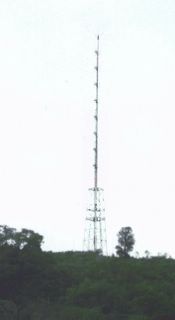
"GBH" stands for Great Blue Hill, the location of WGBH's FM transmitter, as well as the original location of WGBH-TV's transmitter. Great Blue Hill in Milton, Massachusetts, has an elevation of 635 feet (193 m) and is the highest point in the Boston area.
"Hindsight is a wonderful thing. When the Cocteau Twins first emerged, they were compared to Siouxsie & The Banshees. In fact - as each of their records cumulatively proved - the Cocteau Twins never sounded like anything or anyone else. And, taken together, their nine albums, and 16 EPs/singles, sound less like a band and more like an element of nature. A freak of nature, even... Which was very 4AD."
Elizabeth Frazer's unique vocal style and "lyrics" (or lack thereof) have been the centre of much debate.
After the breakup of Cocteau Twins in 1998, Elizabeth Fraser provided vocals for Massive Attack as well as Peter Gabriel's millennium project OvO.
She has subsequently contributed to the soundtracks of several films, most notably The Lord of the Rings: The Fellowship of the Ring, and has occasionally appeared as a guest artist on other musicians' projects.
In 2004, Fraser was invited to participate in an unique audio exhibit, "Shhh...", at London's Victoria and Albert Museum. Though she has released one white label recording called Underwater(which features a number of trance mixes of the title track) and has reportedly signed to Blanco y Negro Records, little is known about the progress of an officially released solo album.
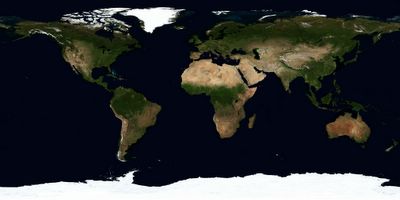
Everyone knows that NASA studies space; fewer people know that NASA also studies the Earth. Since NASA's creation almost 50 years ago, it has been a world leader in space-based studies of our home planet. Earth Observatory
Copernicus- Copernicus' hypothesis contradicted the account of the sun's movement around the earth that appears in the Old Testament (Joshua 10:13). The Flat Earth Society (an obvious joke... we hope)
(also) Gaia - The Earth as spiritual and scientific ecosystem.
I can think of younger days when living for my life Was everything a man could want to do I could never see tomorrow, but I was never told about the sorrow
And how can you mend a broken heart? How can you stop the rain from falling down? How can you stop the sun from shining? What makes the world go round? How can you mend this broken man? How can a loser ever win? Please help me mend my broken heart and let me live again
I can still feel the breeze that rustles through the trees And misty memories of days gone by We could never see tomorrow, No one said a word about the sorrow
And how can you mend a broken heart? How can you stop the rain from falling down? How can you stop the sun from shining? What makes the world go round? How can you mend this broken man? How can a loser ever win? Please help me mend my broken heart and let me live again
This report examines the chain of decisions that slowed federal response to the calamity in New Orleans, government's failure to protect thousands of Americans from a natural disaster that long had been predicted, and the state of America's disaster-response system four years after 9/11.
Correspondent and producer Martin Smith chronicles the disaster and the decision-making and relief efforts, drawing on footage of the devastation and suffering in New Orleans and interviews with key government officials from New Orleans to Washington. The interviews include former Federal Emergency Management Agency Director Michael Brown -- in his first televised interview since he resigned -- Louisiana Governor Kathleen Blanco, New Orleans Mayor Ray Nagin, former Homeland Security Secretary Tom Ridge and former Deputy Secretary James Loy.
Newly Renovated Tokyo Salon offers cocktails, Spanish food, and Cigars for discerning clientele who expect to enter into a space filled with an atmosphere unlike any other. The open-air terrace is especially pleasant throughout Tokyo's warmer seasons. Situated within the hustle and bustle of Las Chicas and in the heart of Aoyama.
As soon as people became aware of their own mortality, writes Karen Armstrong, they created stories that gave their lives meaning, explained their relationship to the spiritual world, and instructed them on how to live their lives. “Human beings fall easily into despair, and from the very beginning we invented stories that enabled us to place our lives in a larger setting, that revealed an underlying pattern, and gave us a sense that, against all the depressing and chaotic evidence to the contrary, life had meaning and value.”
"The Program has been in existence since 1966 and was originally funded through a grant by the Carnegie Foundation and United States Office of Education. In that year the first Metco legislation was filed, the service provider METCO Inc. was established, and seven school districts began accepting the first two hundred Metco students. Currently, there are about 3,300 students participating in 34 school districts in metropolitan Boston and at four school districts outside Springfield."
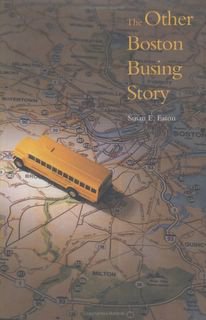
"Many people know the story of Boston's school busing order that went into effect in 1975 and of the violence that it spawned (Forced Busing). Few, however, know about the 'other' Boston busing story the one about Metropolitan Council for Educational Opportunity (METCO), founded in 1966 by black parents and activists as a voluntary school desegregation program."
WGBH Forum Network Discussion about the successes and failures of METCO,
America's longest running voluntary desegregation program. Led by Susan Eaton, author, former METCO student, Gary Orfield, director, Project on School Desegregation
"Settled one month before its neighbor, Boston, in May of 1630, Dorchester has a history nearly as old as that of America. For its first two hundred years, Dorchester remained apart from Boston, existing primarily as a farming community with small commercial and industrial outposts along the Neponset River at Lower Mills and Mattapan Square, and along Dorchester Bay at Commercial Point."
"The battle of Dorchester Heights was on March 6, 1776. General George Washington positioned his troops atop Dorchester Heights, overlooking Boston. This gave the colonists the advantage of targeting the British, who were stationed in the city, below. Washington had hoped General Howe and his troops would either flee or take the hill. Howe chose to flee, and on March 26, the Redcoads evacuated Boston, and headed to Halifax, Nova Scotia."
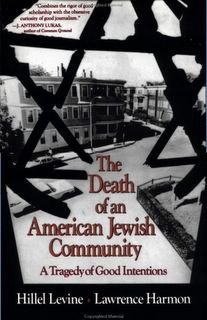
"In a well-researched, instructive, controversial analysis, Levine, a rabbi and director of Judaic Studies at Boston University, and Harmon, former editor of Boston's Jewish Advocate , show how forces external to the black and Jewish communities of Boston undermined their relationship. At issue: blockbusting in the Roxbury-Dorchester-Mattapan sections of the city, where the mid-1960s population of 90,000 Jews has been reduced to 2500."
"The distance between downtown Boston and downtrodden Dudley could not be measured by the less than two miles between them. One area reflected privaledge and reinvestment, the other prejudice and disinvestment. Beginning in the 1950's, disinvestment, abandonment and arson turned Dudley homes, yards and businesses into wasteland. By 1981, one-third of Dudley's land lay vacant." Notable
Lexington, Mass is notable as the site of the opening shots ("the shot heard 'round the world") of the Battle of Lexington and Concord, the first engagement of the American Revolution.
Japan's chances of prosperity and influence look surprisingly bright
"IT HAS taken an extraordinarily long time, but Japan really is now recovering from its debt- and deflation-ridden stagnation of the past 15 years. Proper jobs are being created, wages are rising and economists are raising their forecasts of economic growth—all despite worries about high oil prices and an American slowdown."
Them that’s got shall get Them that’s not shall lose So the Bible said and it still is news Mama may have, papa may have But God bless the child that’s got his own That’s got his own
Yes, the strong gets more While the weak ones fade Empty pockets don’t ever make the grade Mama may have, papa may have But God bless the child that’s got his own That’s got his own
Japan is often perceived as impossible to penetrate or assimilate within. That is true to a point. However, most just don't know how Japan's society has a facet of every part of the world, including black culture. In so many ways, once you get past the language barriers, Japan seems to have more freedom for Africans than not. There is a continual momentum of fundamental change taking place here that often only music can express.
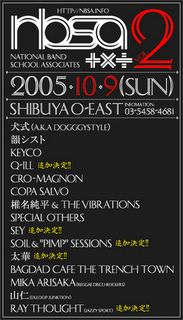
The nbsa fest was unlike none other, and went on for hours. Triumphant, returning from their magnificant Fuji Rock Festival performances, Inushiki ended the 7 hour concert event with an incredible set that left all in awe, friends and fans alike. ("This night has opened my eyes, and I shall never sleep again...")