Tuesday, October 29, 2013

The African Americans - Many Rivers to Cross


In the new six-part series The African Americans: Many Rivers to Cross, Henry Louis Gates, Jr. recounts the full trajectory of African-American history airing six consecutive Tuesdays October 22, 2013 through November 26, 2013.

Written and presented by Professor Gates, the six-hour series explores the evolution of the African-American people, as well as the multiplicity of cultural institutions, political strategies, and religious and social perspectives they developed — forging their own history, culture and society against unimaginable odds. Commencing with the origins of slavery in Africa, the series moves through five centuries of remarkable historic events right up to the present - when America is led by a black president, yet remains a nation deeply divided by race.


Wednesday, October 16, 2013

Afropop Worldwide: Jamaica In New York: The History of Reggae and Dancehall in the Big Apple


Jamaica In New York: The History of Reggae and Dancehall in the Big Apple
Afropop.org
September 26, 2013

New York City has long had a thriving and populous Jamaican community from Crown Heights, Brooklyn to the south Bronx. And as long as Jamaicans have come to the Big Apple they’ve brought their culture and music along with them. In this musical exposé Afropop producer Saxon Baird susses out the often overlooked NYC Jamaican music scene with interviews from some of its biggest players from Bullwackies in the Bronx to Brooklyn-based dancehall artists like Screechy Dan.


PBS - Superheroes: A Never-Ending Battle


SUPERHEROES: A NEVER-ENDING BATTLE is the first documentary to examine the dawn of the comic book genre and its powerful legacy, as well as the evolution of the characters who leapt from the pages over the last 75 years and their ongoing worldwide cultural impact.

3-hour documentary film, Premiers Tuesday October 15, 2013 on PBS.

Saturday, October 05, 2013

Soryu Grape Farm and Winery - Yamashi Prefrecture Japan


Soryu Winery is located in Koshu City, Katsunuma town in Yamanashi Prefecture. It was founded by the families of Masanari Takano and Ryuken Tsuchiya, who traveled to France to learn the proper French winemaking techniques and then pioneered winemaking in Japan. Soryu is one of Katsunuma’s most historic wineries, with annual production equivalent to 1.2 million bottles.


The name of the winery "Soryu Budoshu" originated from "Soryu" which is the God to protect the Eastern Gods protecting East/West/South/North from the ancient Chinese lore and is also the God that brings luck. The winery has been making great wines since 1899 in Katsunuma which has a great climate for growing the best grapes for Japanese wine.


Michael Pollan - Cooked: A Natural History of Transformation


In Cooked, Michael Pollan explores the previously uncharted territory of his own kitchen. Here, he discovers the enduring power of the four classical elements—fire, water, air, and earth— to transform the stuff of nature into delicious things to eat and drink.

Fire, Water, Air, Earth: Michael Pollan Gets Elemental In 'Cooked'
April 21, 2013
NPR Weekend Edition Sunday


NOVA - Earth from Space


NOVA "Earth From Space" is a groundbreaking two-hour special that reveals a spectacular new space-based vision of our planet. NOVA takes data from earth-observing satellites and transforms it into dazzling visual sequences, each one exposing the intricate and surprising web of forces that sustains life on earth. Viewers witness how dust blown from the Sahara fertilizes the Amazon; how a vast submarine "waterfall" off Antarctica helps drive ocean currents around the world; and how the Sun's heating up of the southern Atlantic gives birth to a colossally powerful hurricane. From the microscopic world of water molecules vaporizing over the ocean to the magnetic field that is bigger than Earth itself, the show reveals the astonishing beauty and complexity of our dynamic planet.

Robert Reich - Inequality for All


http://inequalityforall.com/

INEQUALITY FOR ALL examines the crisis of widening income inequality in the US through the eyes and the influential work of Robert Reich

In this timely and entertaining documentary, noted economic policy expert Robert Reich takes on the enormous question of what has been happening to our economy. He distills the story through the lens of widening income inequality -- currently at historic highs -- and and explores what effects this increasing gap has not only on our economy but our democracy itself.

In the wake of the financial crisis and the recent rise of the Occupy movement, the issue of income inequality has gained unprecedented public awareness. Over the last thirty years, the U.S. economy itself doubled. But, these gains went to a very few: the top 1% of earners now take in more than 20% of all income -- three times what they did in 1970. Distortions are even more extreme at the very top. The 400 richest Americans now own more wealth than the bottom 150 million combined. While this level of inequality poses a serious risk to all Americans, regardless of income level, much of the rhetoric on this subject has been fueled by anger and resentment from a frustrated middle class who feel their birthright – the American Dream – has been taken away from them.

Wednesday, September 18, 2013

Frontline - Egypt in Crisis


Less than three years after the popular uprising that led to President Hosni Mubarak’s ouster, and just one year after Egypt’s first free and fair elections, the democratically elected government has been overthrown and the Egyptian military is running the state.

And the Muslim Brotherhood—the secretive, long-outlawed Islamist group that came out of the shadows to win the presidency in June 2012—is once again being driven underground, its members killed and arrested in an army-led campaign to wipe it off the map.

Were the Brothers ever really in charge? Or was the Egyptian “deep state”—embedded remnants of Mubarak’s police force, Supreme Court and, most of all, military—in control all along?

In Egypt in Crisis, FRONTLINE goes inside the Egyptian revolution, tracing how what began as a youth movement to topple a dictator evolved into an opportunity for the Muslim Brotherhood to seemingly find the political foothold it had sought for decades—and then why it all fell apart. “This FRONTLINE documentary takes you deep inside these turbulent ups and downs.”

Sunday, September 01, 2013

Yūrei-Yōkai-ga Complete Works, Sogo Museum of Art Yokohama


SOGO MUSEUM OF ART exhibition if about 160 works et specter ghost images of ukiyo-e, such as ghost picture scroll.

Yūrei

Yūrei (幽霊) are figures in Japanese folklore, analogous to Western legends of ghosts. The name consists of two kanji, 幽 (yū), meaning “faint” or “dim” and 霊 (rei), meaning “soul” or “spirit.” Alternative names include 亡霊 (Bōrei) meaning ruined or departed spirit, 死霊 (Shiryō) meaning dead spirit, or the more encompassing 妖怪 (Yōkai) or お化け (Obake).

Yōkai

Yōkai (妖怪, ghost, phantom, strange apparition) are a class of supernatural monsters in Japanese folklore. The word yōkai is made up of the kanji for “mysterious” and “weird”.[citation needed] Yōkai range eclectically from the malevolent to the mischievous, or occasionally bring good fortune to those who encounter them. Often they possess animal features (such as the Kappa, which is similar to a turtle, or the Tengu which has wings), other times they can appear mostly human, some look like inanimate objects and others have no discernible shape.

Saturday, August 10, 2013

Angkor Wat, Cambodia


Stretching over some 400 square kilometres, including forested area, Angkor Archaeological Park contains the magnificent remains of several capitals of the Khmer Empire of the 9th to the 15th centuries, including the largest pre-industrial city in the world. The most famous are the Temple of Angkor Wat and, at Angkor Thom, the Bayon Temple with its countless sculptural decorations.


Angkor Archaeological Park was declared a UNESCO World Heritage site in 1992. At the same time, it was also placed on the List of World Heritage in Danger due to looting, a declining water table, and unsustainable tourism. UNESCO has now set up a wide-ranging program to safeguard this symbolic site and its surroundings.


Angkor itself has no accommodations and few facilities; the nearby town of Siem Reap, just 6 km. south, is the tourist hub for the area.

The temples of Angkor are highly symbolic structures. The foremost Hindu concept is the temple-mountain, where the temple is built as a representation of the mythical Mount Meru: this is why so many temples, including Angkor Wat itself, are surrounded by moats, built in a mountain-like pyramidal shape and topped by precisely five towers, representing the five peaks of Mount Meru. The linga (phallus), representing the god Shiva, was also critical and while the lingas themselves have largely gone, linga stands (carved, table-like blocks of stone) can be found in many if not most rooms in the temples. There was also a political element to it all: most kings wanted to build their own state temples to symbolize their kingdom and their rule.


While early Angkor temples were built as Hindu temples, Jayavarman VII converted to Mahayana Buddhism c. 1200 and embarked on a prodigious building spree, building the new capital city of Angkor Thom including Bayon, Ta Prohm, Preah Khan and many more as Buddhist structures. However, his successor Jayavarman VIII returned to Hinduism and embarked on an equally massive spree of destruction, systematically defacing Buddhist images and even crudely altering some to be Hindu again. Hinduism eventually lost out to Buddhism again, but the (few) Buddha images in the temples today are later Theraveda additions.


One element that continues to mystify archaeologists is the baray, or water reservoir, built in a grand scale around Angkor: for example, the West Baray is a mind-boggling 8 km by 2.3 km in size. While it has long been assumed that they were used for irrigation, some historians argue that their primary function was political or religious. Not a single outlet has been found, either by eye or by NASA imaging. The moat around Angkor and the West Baray still contains water, but the rest have dried up.


Ankor Wat Located six kilometre north of Siem Reap, Angkor Wat is one of the largest of Khmer monuments. Built around the first half of 12th century by King Suryavarman II, the temple's balance, composition and beauty make it one of the finest monuments in the world.

Though 'Wat' is the Khmer (Cambodian) word for temple, the westward orientation of the structure is atypical of temples. Scholars believe that the architecture and sculptures are that of a temple where Lord Vishnu was worshipped but it was also built as a mausoleum for the king after his death.


Angkor Tom

Built in the latter part of the 12th century by King Jayavarman VII, Bayon is one of the most widely recognised temples in Siem Reap because of the giant stone faces that adorn the towers of Bayon. There are 54 towers of four faces each, totaling 216 faces. There is still a debate as to who is being depicted in the faces. It could be Avalokiteshvara, Mahayana Buddhism's compassionate Bodhisattva, or perhaps a combination of King Jayavarman VII and Buddha.


Ta Prohm Built during the time of king Jayavarman VII and is best known as the temple where trees have been left intertwined with the stonework, much as it was uncovered from the jungle. It might be considered in a state of disrepair but there is a strange beauty in the marvelous strangler fig trees which provide a stunning display of the embrace between nature and the human handiwork. 

This is one of the most popular temples after Angkor Wat and the Bayon because of the beautiful combinations of wood and stone. Black and white film photographers especially love this site because of this and most of the stunning postcard shots of Angkor's trees come from here; pop culture fans, on the other hand, may recognise a few scenes from Angelina Jolie's Tomb Raider. 

While the temple is very popular, most visitors follow a central route and the sides of the complex can be surprisingly quiet. Note that large sections of the temple are unstable rubble and have been cordoned off, as they are in real danger of collapse. As of 2010, authorities have started to restore Ta Prohm. All the plants and shrubs have been cleared from the site and some of trees are also getting removed. A crane has been erected and a large amount of building work is underway to rebuild the temple, much of it seemingly from scratch. Wooden walkways now block some of the previously famous postcard photos. People that want to take a pretty picture of a building overgrown by a huge tree without the crowds, walkways, cranes etc. might want to check out the gatehouse in the back of the Ta Som complex instead.

Wednesday, July 17, 2013

Eric Holder FULL NAACP Speech. We Must Stand Our Ground. 7/16/2013


Attorney General Eric Holder took aim Tuesday at "Stand Your Ground"-style laws — such as the one that figured into the George Zimmerman case — saying they may encourage violence and "undermine public safety."

"It's time to question laws that senselessly expand the concept of self-defense and sow dangerous conflict in our neighborhoods," Holder said in a speech to the NAACP in which he again called the death of Trayvon Martin “unnecessary.”

"These laws try to fix something that was never broken,” he said.

Sunday, June 23, 2013

JAXA Tsukuba Space Center, Tsukuba, Japan


The Tsukuba Space Center (TKSC) is the operations facility for the Japan Aerospace Exploration Agency (JAXA) located in Tsukuba Science City in Ibaraki Prefecture.


The facility opened in 1972 and serves as the primary location for Japan's space operations and research programs. Japanese astronauts involved in the International Space Station are trained in part here in addition to the training they receive at the Johnson Space Center, in Houston, Texas.


JAXA, The Japan Aerospace Exploration Agency, is Japan's national aerospace agency. Through the merger of three previously independent organizations, JAXA was formed on 1 October 2003. JAXA is responsible for research, technology development and the launch of satellites into orbit, and is involved in many more advanced missions, such as asteroid exploration and possible manned exploration of the Moon.


The Tanegashima Space Center (TNSC) was established in 1969, when the original National Space Development Agency of Japan (NASDA) was formed.


The TNSC is the largest rocket-launch complex in Japan (9,700,000 square meters) and is located in the south of Kagoshima Prefecture, along the southeast coast of Tanegashima. It is known as the most beautiful rocket-launch complex in the world, located on Tanegashima island located 115 km south of Kyushu. The activities that take place at TNSC and include assembly, testing, launching and tracking of satellites, as well as rocket engine firing tests. It is Japan's largest space development center.


Tuesday, May 21, 2013

Hiroshima Peace Memorial Museum


The Hiroshima Peace Memorial Museum collects and displays the belongings left by the victims, photos, and other materials that convey the horror of the world's first atomic bombing of populated area on August 6, 1945.

Atomic (Genbaku) Dome
The Hiroshima Peace Memorial (Genbaku Dome) was the only structure left standing in the area where the first atomic bomb exploded on 6 August 1945. The building was the only one left standing near the epicenter of the bomb blast, albeit in skeletal form.


Through the efforts of many people, including those of the city of Hiroshima, the build has been preserved in the same state as immediately after the bombing. Not only is it a stark and powerful symbol of the most destructive force ever created by humankind; it also expresses the hope for world peace and the ultimate elimination of all nuclear weapons.


The Peace Memorial Park, in which the Dome is the principal landmark, was laid out between 1950 and 1964. The Peace Memorial Museum in the Park was opened in 1955. Since 1952 the Park has been the scene of the Hiroshima Peace Memorial Ceremony, held annually on 6 August.


The Hiroshima Peace Memorial is a stark and powerful symbol of the achievement of world peace for more than half a century following the unleashing of the most destructive force ever created by humanity. It was preserved in that state when reconstruction of the city began. In 1966 the Hiroshima City Council adopted a resolution that the Atomic Bomb Dome should be preserved in Perpetuity.

Monday, May 20, 2013

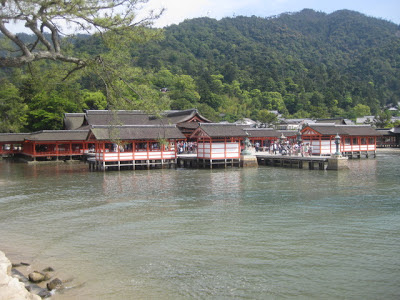
Itsukushima - Miyajima, Hatsukaichi - Hiroshima, Japan


Itsukushima is an island in the western part of the Inland Sea of Japan, located in the northwest of Hiroshima Bay. It is popularly known as Miyajima the Shrine Island, best known for its famous "floating" O-torii gate. The shrine complex is listed as a UNESCO World Heritage Site and the Japanese government has designated several buildings and possessions as National Treasures. The area designated for World Heritage comprises of the 431 hectares including the Itsukushima Shrine, and the adjacent sea, and the Mt Misen Primeval Forest (National Treasure) to the rear.


The O-torii Gate is about 16 meters in height and weighs about 60 tons. The main pillars are 9.9 meters in circumference, and made of natural camphor trees, while the four supporting pillars are made of natural cedar. The present O-torii was erected in 1875, and the eighth since the Heian Period (the last division of classical Japanese history, running from 794 to 1185).

According to records, the shrine was established in the time of Empress Suiko. The warrior-courtier Taira no Kiyomori gave the shrine its present form. In 1555, Mōri Motonari defeated Sue Harukata at the Battle of Miyajima. Toyotomi Hideyoshi built a large building, the Senjō-kaku, on a hill above the shrine.


The first shrine buildings were probably erected in the 6th century, and the shrine has been destroyed many times. The present shrine dates from the mid-16th century, and follows the earlier 12th century design. That design was established in 1168, when funds were provided by the warlord Taira no Kiyomori.


The island of Itsukushima, including the waters around it (part of Seto Inland Sea), are within Setonaikai National Park. This sea is affected by strong tides. At low tide, the bottom of the sea is exposed past the island's O-torii. At high tide, the sea covers all the previously exposed mud and fills areas underneath the shrine.


The Itsukushima Shrine at high tide, when it appears to float on the water. The shrine was designed and built on pier-like structures over the bay so that it would appear to be floating on the water, separate from the sacred island, which could be approached by the devout.


Mt. Misen is the highest peak on Miyajima island, 535 meters above sea level. Since the year 806 it has attracted devout worshipers. The natural environment has been kept intact which creates magnificent scenery.

Mt. Misen Ropeway (unfortunately it was a rainy day)
The Miyajima Ropeway is a network of gondolas that traverse the island, which is rare and unique in Japan and is often described as walking in the sky.

Wait at the ropeway station platform between gondola changes
Kiezu-no-Reikado Hall is located about 20 minutes on foot from Shishiiwa Ropeway Station. The holy fire that Kobo Daishi lit for his ascetic training has been kept burning for over 1,200 years in Reikado Hall. The hall has been designated a "Lover:s Sanctuary" as the flame is akin to the eternal fire of love.

Kiezu-no-Reikado Hall


Tuesday, May 07, 2013

Akira Kurosawa - Rashomon


Rashomon is a 1950 Japanese drama directed by Akira Kurosawa. The film depicts the rape of a woman and the murder of her samurai husband through the widely differing accounts of four witnesses, including the bandit/rapist, the wife, the dead man (speaking through a medium), and lastly a woodcutter, the one witness that seems the most objective and least biased. Kurosawa when asked by his assistants to explain his script explained “Human beings are unable to be honest with themselves about themselves. They cannot talk about themselves without embellishing. This script portrays such human beings—the kind who cannot survive without lies to make them feel they are better people than they really are.”

Monday, April 29, 2013

Ken Burns - The Central Park Five


THE CENTRAL PARK FIVE, a new film from award-winning filmmaker Ken Burns, tells the story of the five black and Latino teenagers from Harlem who were wrongly convicted of raping a white woman in New York City’s Central Park in 1989. The film chronicles The Central Park Jogger case, for the first time from the perspective of these five teenagers whose lives were upended by this miscarriage of justice.


Watch The Central Park Five on PBS. See more from Central Park Five.


The Daily Show with Jon StewartMon - Thurs 11p / 10c
Ken Burns
www.thedailyshow.com
Daily Show Full EpisodesIndecision Political HumorThe Daily Show on Facebook


Friday, January 25, 2013

DNA Data Storage


Two British scientists have demonstrated a possible solution to future enormous data storage challenges by storing all of Shakespeare's sonnets on several small stretches of DNA. The four letters in DNA's alphabet — the nucleotides commonly abbreviated as A, C, G and T, are used to corrolate the same binary numbers address numbers 1010.

Shall I Encode Thee In DNA? Sonnets Stored On Doulbe Helix
NPR Morning Edition
Jan 24, 2013


Shakespeare's Sonnets, Encoded In DNA
NPR Talk of the Nation, Science Friday
Jan 26, 2013

Thursday, January 24, 2013

NOVA - Rise of the Drones


NOVA: Rise of the Drones
Aired January 23, 2013 on PBS

"Drones. These unmanned flying robots–some as large as jumbo jets, others as small as birds–do things straight out of science fiction. Much of what it takes to get these robotic airplanes to fly, sense, and kill has remained secret. But now, with rare access to drone engineers and those who fly them for the U.S. military, NOVA reveals the amazing technologies that make drones so powerful as we see how a remotely-piloted drone strike looks and feels from inside the command center. From cameras that can capture every detail of an entire city at a glance to swarming robots that can make decisions on their own to giant air frames that can stay aloft for days on end, drones are changing our relationship to war, surveillance, and each other. And it's just the beginning."


Watch Rise of the Drones on PBS. See more from NOVA.

Wednesday, January 23, 2013

Regenesis


Regenesis by George Church

Amazon.com


"Imagine a future in which human beings have become immune to all viruses, in which bacteria can custom-produce everyday items, like a drinking cup, or generate enough electricity to end oil dependency. Building a house would entail no more work than planting a seed in the ground. These scenarios may seem far-fetched, but pioneering geneticist George Church and science writer Ed Regis show that synthetic biology is bringing us ever closer to making such visions a reality.

In Regenesis, Church and Regis explorethe possibilities—and perils—of the emerging field of synthetic biology. Synthetic biology, in which living organisms are selectively altered by modifying substantial portions of their genomes, allows for the creation of entirely new species of organisms. Until now, nature has been the exclusive arbiter of life, death, and evolution; with synthetic biology, we now have the potential to write our own biological future. Indeed, as Church and Regis show, it even enables us to revisit crucial points in the evolution of life and, through synthetic biological techniques, choose different paths from those nature originally took."

Is Creating New Life — Maybe Even A Neanderthal — Possible?
January 23, 2013
NPR On Point with Tom Ashbrook