"My time, just the moment between the pillow and sleep,
Vacations spent working elsewhere,
When I could be sleeping,
Sitting is a luxury, only dreams are my refuge"
"Eight days, three hours, 18 minutes, 35 seconds. That is the total duration of the most important and celebrated space mission ever flown - Apollo 11 - when humans first set foot on the moon. It was a journey that changed the way we think about our place in the universe. But we only saw a fraction of what happened - a handful of iconic stills and a few precious hours of movie footage. Now it is time to discover the full story."
PBS, July 10, 2019 Back to the Moon "On the 50th anniversary of the historic Apollo 11 Moon landing, NOVA looks ahead to the hoped-for dawn of a new age in lunar exploration. This time, governments and private industry are working together to reach our nearest celestial neighbor. But why go back? The Moon can serve as a platform for basic astronomical research; as an abundant source of rare metals and hydrogen fuel; and ultimately as a stepping stone for human missions to Mars and beyond. Join the next generation of engineers that aim to take us to the Moon, and discover how our legacy of lunar exploration won't be confined to the history books for long."
While George Washington Carver's rise from slavery to scientific accomplishment has inspired millions, time has dulled the luster of his reputation, reducing him to the man who did something with peanuts. This documentary uncovers Carver's complexities and reveals the full impact of his life and work.
Inner Worlds, Outer Worlds is a documentary film created by Canadian film maker and meditation teacher Daniel Schmidt. The film was released in 2012.
"The true crisis in our world is not social, political, or economic, our crisis is the crisis of consciousness: an inability to directly experience our true nature, an inability to recognize this nature in everyone and in all things."
Mandelbrot Equation (a.k.a. The Thumbprint of God)
In mathematics, the Fibonacci numbers are the numbers in the following integer sequence, called the Fibonacci sequence, and characterized by the fact that every number after the first two is the sum of the two preceding ones:
The sequence Fn of Fibonacci numbers is defined by the recurrence relation:
"THE FARTHEST tells the captivating tales of the people and events behind one of humanity’s greatest achievements in exploration: NASA’s Voyager mission, which celebrates its 40th anniversary this August. The twin spacecraft—each with less computing power than a cell phone—used slingshot trajectories to visit Jupiter, Saturn, Uranus and Neptune. They sent back unprecedented images and data that revolutionized our understanding of the spectacular outer planets and their many peculiar moons."
Engineers are using origami to design drugs, micro-robots, and future space missions.
The centuries-old tradition of folding two-dimensional paper into three-dimensional shapes is inspiring a scientific revolution. The rules of folding are at the heart of many natural phenomena, from how leaves blossom to how beetles fly. But now, engineers and designers are applying its principles to reshape the world around us—and even within us, designing new drugs, micro-robots, and future space missions. With this burgeoning field of origami-inspired-design, the question is: can the mathematics of origami be boiled down to one elegant algorithm—a fail-proof guidebook to make any object out of a flat surface, just by folding? And if so, what would that mean for the future of design? Explore the high-tech future of this age-old art as NOVA unfolds “The Origami Revolution.”
Saturday, October 29, 2016
Oct 28, 2016, during a press event at Universal Studios in L.A., Elon Musk announces that Tesla will build and sell its own line of solar panels with integrated batteries. Coupled with the also unveiled PowerWall 2, it will allow residential homeowners to replace their entire roof with solar panels, making it much simpler for homes to be entirely powered by solar power.
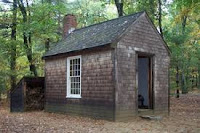
The Walden Pond Reservation is located in Concord and Lincoln, Massachusetts. The reservation's principal feature is Walden Pond, a 64.5-acre fresh body of water.
The writer, transcendentalist, and philosopher Henry David Thoreau lived on the northern shore of the pond for two years starting in the summer of 1845. His account of the experience was recorded in Walden; or, Life in the Woods, and made the pond famous.
Boston's "Ice King," Frederic Tudor, harvested ice yearly on Walden Pond for export to the Caribbean, Europe, and India. In his journal, Thoreau philosophized upon the wintry sight of Tudor's ice harvesters: "The sweltering inhabitants of Charleston and New Orleans, of Madras and Bombay and Calcutta, drink at my well ... The pure Walden water is mingled with the sacred water of the Ganges."
In addition to being a popular swimming destination in the summer, Walden Pond State Reservation provides opportunities for boating, baptizing, hiking, picnicking, and fishing.
Space is humanity’s great fever dream. It’s a place that’s unfathomably beautiful, yet lethally dangerous, a place that’s been beckoning us to visit for millions of years but that we have only recently begun to touch..."
NOVA and National Geographic present exclusive access to a unique discovery of ancient remains. Located in an almost inaccessible chamber deep in a South African cave, the site required recruiting a special team of experts slender enough to wriggle down a vertical, pitch-dark, seven-inch-wide passage. Most fossil discoveries of human relatives consist of just a handful of bones. But down in this hidden chamber, the team uncovered an unprecedented trove—so far, over 1,500 bones—with the potential to rewrite the story of our origins. They may help fill in a crucial gap in the fossil record and tell us how Homo, the first member of the human family, emerged from ape-like ancestors like the famous Lucy. But how did hundreds of bones end up in the remote chamber? The experts are considering every mind-boggling possibility. Join NOVA on the treacherous descent into this cave of spectacular and enigmatic finds, and discover their startling implications for the saga of what made us human.
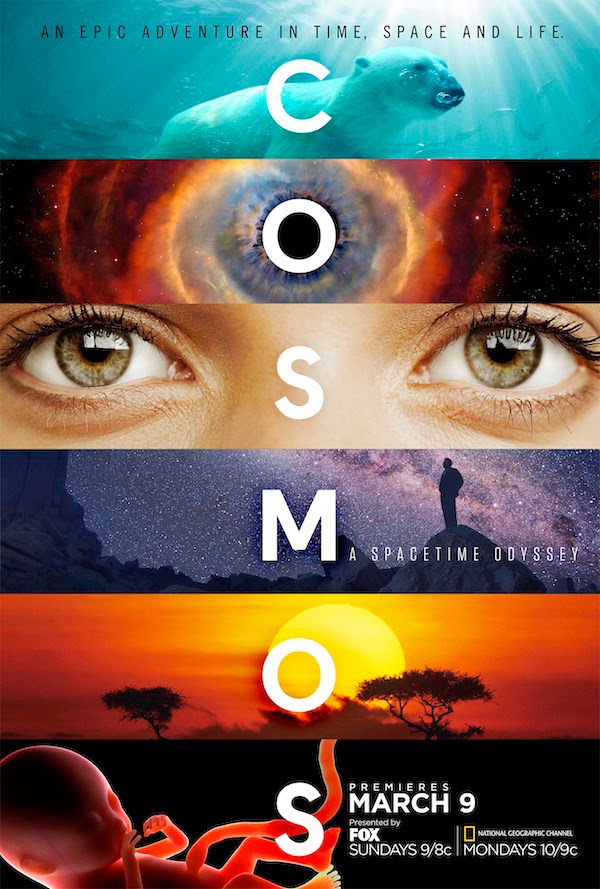
Cosmos: A Spacetime Odyssey explores how we discovered the laws of nature and found our coordinates in space and time. It will bring to life never-before-told stories of the heroic quest for knowledge and transport viewers to new worlds and across the universe for a vision of the cosmos on the grandest scale.
Episode 1 "Standing Up in the Milky Way"
Episode 2 "the Things That Molecules Do"
Episode 3 "When Knowledge Conquered Fear"
Episode 4 "A Sky Full of Ghosts"
Episode 5 "Hiding in the Light"
Episode 6 "Deeper, Deeper, Deeper Still"
Episode 7 "The Clean Room"
Episode 8 "Sisters of the Sun"
Episode 9 "The Electric Boy"
Episode 10 "The Lost Worlds of Planet Earth"
Episode 11 "The Immortals"
Episode 12 "The World Set Free"
Episode 13 "Unafraid of the Dark"
Cosmos: A Personal Voyage is a thirteen-part television series by Sagan also as presenter. The series was first broadcast by the Public Broadcasting Service in 1980, and was the most widely watched series in the history of American public television until The Civil War (1990).
NOVA "Earth From Space" is a groundbreaking two-hour special that reveals a spectacular new space-based vision of our planet. NOVA takes data from earth-observing satellites and transforms it into dazzling visual sequences, each one exposing the intricate and surprising web of forces that sustains life on earth. Viewers witness how dust blown from the Sahara fertilizes the Amazon; how a vast submarine "waterfall" off Antarctica helps drive ocean currents around the world; and how the Sun's heating up of the southern Atlantic gives birth to a colossally powerful hurricane. From the microscopic world of water molecules vaporizing over the ocean to the magnetic field that is bigger than Earth itself, the show reveals the astonishing beauty and complexity of our dynamic planet.
Two British scientists have demonstrated a possible solution to future enormous data storage challenges by storing all of Shakespeare's sonnets on several small stretches of DNA. The four letters in DNA's alphabet — the nucleotides commonly abbreviated as A, C, G and T, are used to corrolate the same binary numbers address numbers 1010.
Retrospective film almost a year after a tsunami crippled Japan's Fukushima power plant. How a small group of engineers, soldiers and firemen risked their own lives to prevent a complete nuclear meltdown.
Film “a gripping account of a series of potentially catastrophic developments in how the government, plant workers and citizens responded. Describing in detail the days after the earthquake and tsunami from rumors about evacuating Tokyo to a dangerous mission to vent one of the reactors and offers insight into what the workers were thinking during those uncertain hours.
Knocking on Heaven's Door: How Physics and Scientific Thinking Illuminate the Universe and the Modern World
By Lisa Randall
Physicist Lisa Randall On Cosmology And The LHC
NPR Talk of the Nation, Science Friday
September 30, 2011
Harvard physicist Lisa Randall talks about her new book, Knocking On Heaven's Door, an examination of the latest findings in cosmology and the history of scientific thought, and discusses a report that suggests neutrinos can travel faster than the speed of light.