Tuesday, May 24, 2011

Frontline: WikiSecrets


WikiSecrets: The inside story of Bradley Manning, Julian Assange and the largest intelligence breach in U.S. history.


Watch the full episode. See more FRONTLINE.

Wednesday, May 11, 2011

Nikki Rosa (It is Well)

Nikki Rosa (It is Well)
By Nikki Giovanni
Truth is on Its Way

childhood remembrances are always a drag if you’re Black
you always remember things like living in Woodlawn with no inside toilet
and if you become famous or something they never talk about how happy you were to have your mother all to yourself
and how good the water felt when you got your bath from one of those big tubs that folk in chicago barbecue in
and somehow when you talk about home it never gets across how much you understood their feelings as the whole family attended meetings about Hollydale
and even though you remember your biographers never understand your father’s pain as he sells his stock and another dream goes
And though you’re poor it isn’t poverty that concerns you and though they fought a lot it isn’t your father’s drinking that makes any difference
but only that everybody is together and you and your sister have happy birthdays and very good Christmases
and I really hope no white person ever has cause to write about me because they never understand Black love is Black wealth
and they’ll probably talk about my hard childhood and never understand that all the while I was quite happy


Tuesday, April 19, 2011

Black in Latin America


Black in Latin America is the third of a trilogy that began in 1999 with the broadcast of Professor Henry Louis Gates’ first series for public television, Wonders of the African World, an exploration of the relationship between Africa and the New World, a story he continued in 2004 with America Beyond the Color Line, a report on the lives of modern-day African Americans. Black In Latin America, premiering nationally Tuesdays; April 19, 26 and May 3, 10, 2011 at 8 p.m. (ET) on PBS, examines how Africa and Europe came together to create the rich cultures of Latin America and the Caribbean.

Haiti & The Dominican Republic: An Island Divided
In the Dominican Republic, Professor Gates explores how race has been socially constructed in a society whose people reflect centuries of inter-marriage, and how the country’s troubled history with Haiti informs notions about racial classification. In Haiti, Professor Gates tells the story of the birth of the first-ever black republic, and finds out how the slaves’s hard fought liberation over Napoleon Bonaparte’s French Empire became a double-edged sword.

Cuba: The Next Revolution
In Cuba Professor Gates finds out how the culture, religion, politics and music of this island are inextricably linked to the huge amount of slave labor imported to produce its enormously profitable 19th century sugar industry, and how race and racism have fared since Fidel Castro’s Communist revolution in 1959.

Brazil: A Racial Paradise?
In Brazil, Professor Gates delves behind the façade of Carnival to discover how this ‘rainbow nation’ is waking up to its legacy as the world’s largest slave economy.

Mexico & Peru: A Hidden Race
In Mexico and Peru Professor Gates explores the almost unknown history of the significant numbers of black people—the two countries together received far more slaves than did the United States —brought to these countries as early as the 16th and 17th centuries, and the worlds of culture that their descendants have created in Vera Cruz on the Gulf of Mexico, the Costa Chica region on the Pacific, and in and around Lima, Peru.


NPR Talk of the Nation
Series Explores Being 'Black In Latin America'
April 18, 2011

Excerpt from Transcript:

"Mr. GATES:

Oh, it was fundamental. Like many people - remember, I was raised in the '50s and '60s. I'm 60 years old. And like many people my age, I thought that slavery, race, the African experience in the New World, really was about us, about our ancestors here in the Continental United States.

But the most astonishing fact in this whole series, and the most astonishing fact which I think that the Transatlantic Slave Trade database has produced is the following: Between 1502 and 1867, 11.2 million Africans survived the Middle Passage and landed in the New World. And of that 11.2 million, as you said, only 450,000 came to the United States.

All the rest, Neal, went to places, as it were, south of Miami, south of our borders. The real African-American experience, as it were, just in terms of numbers alone, unfolded in the Caribbean and throughout Latin America.

And so I wanted to do a series bringing this lost or hidden black world to light, both to Americans and to many of the black descendents, the Afro descendents, throughout Latin America themselves."


Trans-Atlantic Slave Trade Database
http://slavevoyages.org/

The Trans-Atlantic Slave Trade Database has information on almost 35,000 slaving voyages that forcibly embarked over 10 million Africans for transport to the Americas between the sixteenth and nineteenth centuries. It offers researchers, students and the general public a chance to rediscover the reality of one of the largest forced movements of peoples in world history.

Overview of Slave Trade 1500-1900
The Voyages website provides the most comprehensive source of data currently available on the trans-Atlantic slave trade. Forming its core is the Voyages Database, originally published as the Trans-Atlantic Slave Trade: A Database -on CD-ROM by Cambridge University Press (1999), and this data-file is provided here in 
an expanded and continually growing form. The Voyages Database contains records of nearly 35,000 separate slaving voyages between 1514 and 1866, gleaned from original documents and historical publications located in archives, libraries, and other institutions throughout the world. Data from these historical records were collected over many decades and will continue to be updated as new documents are discovered. Individuals will be able to contribute their own research to this collaborative resource. Each record in the Voyages Database offers information on a single slaving voyage; some of the details include the country of origin, the individual(s) who sponsored it, the voyage itself (its itinerary, dates of travel, and outcome), captains and crew members, slaves transported, and the sources providing this voyage information.

Volume and Direction of the Transatlantic Slave Trade
from All African to All American Regions


Tuesday, April 12, 2011

Artificial Leaves Produce Hydrogen Fuel from Water


A Greener 'Artificial Leaf'
New device offers distinct advantages over previous attempts to improve upon natural photosynthesis.
MIT Technology Review
April 7, 2011

Growing The Technology For Artificial Leaves
NPR Talk of the Nation, Science Friday
April 8, 2011

"Researchers are developing practical, low-cost materials that can use energy from sunlight to break water into oxygen and hydrogen. Daniel Nocera of MIT explains the science of "artificial photosynthesis," and describes his plan to create distributed power generation systems in developing countries."

Friday, April 01, 2011

NOVA: Japan's Killer Quake


NOVA: Japan's Killer Quake


An eyewitness account and investigation of the epic earthquake, tsunami, and nuclear crisis.
Aired March 30, 2011 on PBS

In its worst crisis since World War II, Japan faces disaster on an epic scale: a death toll likely in the tens of thousands, massive destruction of homes and businesses, shortages of water and power, and the specter of nuclear meltdown. With exclusive footage, NOVA captures the unfolding human drama and offers a clear-headed investigation of what triggered the earthquake, tsunami, and subsequent nuclear crisis. Can science and technology ever prevent devastation in the face of overwhelmingly powerful forces of nature?

Watch below 53:07 (only available online in the U.S., I had to access it via a U.S. proxy server to view it)


Watch the full episode. See more NOVA.


Wednesday, March 30, 2011

Tohoku earthquake and tsunami


The 2011 Tohoku earthquake and tsunam was caused by a 9.0-magnitude earthquake off the coast of Japan that occurred at 14:46 JST on Friday, 11 March, 2011. The earthquake triggered extremely destructive tsunami waves of up to 30 m (98 ft) that struck Japan minutes after the quake, in some cases traveling up to 10 km (6 mi) inland, with smaller waves reaching many other countries after several hours.

Aftershocks

The nearest major city to the quake was Sendai, Honshu, Japan, 130 km (81 mi) away. The quake occurred 373 km (232 mi) from Tokyo. The main earthquake was preceded by a number of large foreshocks, and multiple aftershocks were reported afterwards. The first major foreshock was a 7.2 MW event on 9 March, approximately 40 km (25 mi) from the location of the 11 March quake, with another three on the same day in excess of 6.0 MW. Following the quake, a 7.0 MW aftershock was reported at 15:06 JST, followed by a 7.4 at 15:15 JST and a 7.2 at 15:26 JST. Over six hundred aftershocks of magnitude 4.5 or greater have occurred since the initial quake.

Date/Time Magnitude

Warning Shock
3/9 11:45 M7.2

Major Quake
3/11 14:46 M9.0

Major Aftershocks
3/11 15:06 M7.4
3/11 15:15 M7.4
3/11 15:26 M7.5
3/11 16:29 M6.6
3/11 17:41 M5.8
3/11 20:37 M6.4
3/12 3:59 M6.7
3/12 4:32 M5.8
3/12 5:42 M5.3
3/12 22:15 M6.0
3/12 23:35 M4.4
3/13 8:25 M6.2
3/14 10:02 M6.2
3/15 22:31 M6.4
3/16 12:52 M6.0
3/19 18:56 M6.1
3/23 12:07 M6.0
3/23 7:36 M5.8
3/23 18:55 M4.7
3/24 8:56 M4.9
3/24 21:17 M6.1
3/28 7:24 M6.5


Tsunami


The actual height predicted varied, the greatest being for Miyagi at 10 m (33 ft) high. The tsunami inundated a total area of approximately 470 square kilometers in Japan. The earthquake took place at 14:46 JST around 67 km (42 mi) from the nearest point on Japan's coastline, and initial estimates indicated the tsunami would have taken 10 to 30 minutes to reach the areas first affected, and then areas further north and south based on the geography of the coastline. Just over an hour after the earthquake at 15:55 JST, a tsunami was observed flooding Sendai Airport, which is located near the coast of Miyagi Prefecture, with waves sweeping away cars and planes and flooding various buildings as they traveled inland. The impact of the tsunami in and around Sendai Airport was filmed by an NHK News helicopter, showing a number of vehicles on local roads trying to escape the approaching wave and being engulfed by it. A 4-meter (13 ft)-high tsunami hit Iwate Prefecture. Wakabayashi Ward in Sendai was also particularly hard hit.


Nuclear Crisis

The Fukushima I nuclear accidents  are a series of ongoing equipment failures and releases of radioactive materials at the Fukushima I Nuclear Power Plant, following the earthquake and tsunami. The plant comprises six separate boiling water reactors maintained by the Tokyo Electric Power Company (TEPCO). Reactors 4, 5 and 6 had been shut down prior to the earthquake for planned maintenance. The remaining reactors were shut down automatically after the earthquake, but the subsequent 14 metres (46 ft) tsunami flooded the plant, knocking out emergency generators needed to run pumps which cool and control the reactors. The flooding and earthquake damage prevented assistance being brought from elsewhere.
Reactor Explosion
Evidence arose of partial core meltdown in reactors 1, 2, and 3; hydrogen explosions destroyed the upper cladding of the buildings housing reactors 1, 3, and 4; an explosion damaged the containment inside reactor 2; and multiple fires broke out at reactor 4. In addition, spent fuel rods stored in spent fuel pools of units 1–4 began to overheat as water levels in the pools dropped. Fears of radiation leaks led to a 20 kilometres (12 mi) radius evacuation around the plant. Workers at the plant suffered radiation exposure and were temporarily evacuated at various times. On 18 March, Japanese officials designated the magnitude of the danger at reactors 1, 2 and 3 at level 5 on the 7 point International Nuclear Event Scale (INES). Power was restored to parts of the plant from 20 March, but machinery damaged by floods, fires and explosions remained inoperable.

Exclusion Zone

Aftermath


The latest confirmed toll to date are over 10,000 deaths with 16,361 people missing across eighteen prefectures. These numbers are expected to increase, with casualties estimated to reach tens of thousands.
Prefectural officials and the Kyodo News Agency, quoting local officials, said that 9,500 people from Minamisanriku in Miyagi Prefecture—about a half of the town's population—were unaccounted for. NHK has reported that the death toll in Iwate Prefecture alone may reach 10,000. Save the Children reports that as many as 100,000 children have been uprooted from their homes, some of whom were separated from their families because the earthquake occurred during the school day. On 14 March, Kyodo News Agency reported that some 2,000 bodies were found on two shores in Miyagi Prefecture. It was reported that four passenger trains containing an unknown number of passengers disappeared in a coastal area during the tsunami.

The earthquake caused a large number of displaced people. The number of the evacuees has once passed 300,000. Some earthquake survivors died in the shelters or in the process of evacuation. Many shelters struggle to feed evacuees and are not medically sufficiently equipped. Fuel shortages hampered relief actions. In the first week after the earthquake, supplies of food, water, and medicine had been held up because of a fuel shortage and the weather condition. There is a need for temporary housing, as the Japanese government are trying to remove evacuees from large shelters, where there have been reports of poor sanitary conditions. As of late March, 8,800 temporary units were planned in Iwate, 10,000 in Miyagi, and 19,000 in Fukushima.

The nuclear crisis and recover continues unabated. The Japanese people remain otherwise calm and stoic about the ongoing situation, the disaster across of the Northeastern region of Tohoku, and the overall future of Japan.

Monday, February 28, 2011

This American Life: DIY


This American Life: #282 DIY
Original Broadcast Feb 11, 2005


After four lawyers fail to get an innocent man out of prison, his friend takes on the case himself. He becomes a do-it-yourself investigator. He learns to read court records, he tracks down hard-to-find witnesses, he gets the real murderer to come forward with his story. In the end, he's able to accomplish all sorts of things the police and the professionals can't.

Monday, February 07, 2011

A Change Is Gonna Come


A Change Is Gonna Come
Sam Cooke

I was born by the river in a little tent
Oh and just like the river I've been running ever since
It's been a long, a long time coming 
But I know a change gonna come, oh yes it will 

It's been too hard living but I'm afraid to die 
Cause I don't know what's up there beyond the sky 
It's been a long, a long time coming 
But I know a change gonna come, oh yes it will 

I go to the movie and I go downtown 
somebody keep telling me don't hang around 
It's been a long, a long time coming 
But I know a change gonna come, oh yes it will 

Then I go to my brother 
And I say brother help me please 
But he winds up knockin' me 
Back down on my knees 

There been times that I thought I couldn't last for long 
But now I think I'm able to carry on 
It's been a long, a long time coming 
But I know a change gonna come, oh yes it will 

Sunday, January 16, 2011

Frontline: The Battle for Haiti


Frontline: Battle For Haiti

Can Haiti be rebuilt without the rule of law? A year after the earthquake, a powerful look at the violence threatenin the country's stability .. and future.


Watch the full episode. See more FRONTLINE.


On the night of the earthquake that devastated Haiti last January, something happened in Port au Prince, the capital city, which would threaten the effectiveness of international aid efforts and undermine the country's political stability: 4,500 of the country's most violent criminals escaped from Haiti's overcrowded National Penitentiary.

Now, on the one-year anniversary of the quake -- and in the aftermath of Haitian presidential elections that threatened further crisis -- FRONTLINE presents Battle for Haiti. FRONTLINE producer Dan Reed films with the beleaguered special police units tasked with apprehending the escaped gangsters. At the same time, Reed captures the daily lives of the despairing inhabitants of the slums and tent cities who are often terrorized by these gangsters.

National Geographic - Population 7 Billion


"Before the 20th century, no human had lived through a doubling of the human population, but there are people alive today who have seen it triple. Sometime in late 2011, according to the UN Population Division, there will be seven billion of us.

With the population still growing by about 80 million each year, it’s hard not to be alarmed. Right now on Earth, water tables are falling, soil is eroding, glaciers are melting, and fish stocks are vanishing. Close to a billion people go hungry each day. Decades from now, there will likely be two billion more mouths to feed, mostly in poor countries. There will be billions more people wanting and deserving to boost themselves out of poverty. If they follow the path blazed by wealthy countries—clearing forests, burning coal and oil, freely scattering fertilizers and pesticides—they too will be stepping hard on the planet’s natural resources. How exactly is this going to work?"

Thursday, January 13, 2011

BBC - How Earth Made Us

How Earth Made Us
Presented by Professor Iain Stewart describing untold stories of history. Our planet has amazing power, and yet that's rarely mentioned in our history books. This series tells the story of how the Earth has influenced human history, from the dawn of civilization to the modern industrial age. It reveals for the first time on television how geology, geography and climate have been a far more powerful influence on the human story than has previously been acknowledged. A combination of epic story telling, visually stunning camera work, extraordinary locations and passionate presenting combine to form a highly original version of human history.

Discover why societies have succeeded or failed, and how the environment has influenced every aspect of our history from art to industry, religion to war, world domination or collapse. Visiting some of the most iconic places on Earth, How Earth Made Us overturns preconceptions about our civilizations and our cultures to offer a new perspective on who we are today.

1. Deep Earth
2. Water
3. Wind
4. Fire
5. Human Planet

BBC - Earth The Power of the Planet

BBC Earth The Power of the Planet

Dr Iain Stewart tells the story of how Earth works and how, over the course of 4.6 billion years, it came to be the remarkable place it is today.

1. Volcano
2. Atmosphere
3. Ice
4. Oceans
5. Rare Earth

BBC - The Story of India with Michael Wood


The Story of India is a BBC TV documentary series, written and presented by historian Michael Wood, about the 10,000-year history of the Indian subcontinent in six episodes.

Episode 1 - "Beginnings"

Travels through the subcontinent, tracing the richness and diversity of its peoples, cultures and landscapes. Through ancient manuscripts and oral tales Wood charts the first human migrations out of Africa. He travels from the tropical backwaters of South India through lost ancient cities in Pakistan to the vibrant landscapes of the Ganges plain, also attempts to re-create soma, an ancient drink recorded in the Rig Veda.

Episode 2 - "The Power of Ideas"

Episode moves on to the revolutionary years after 500BC - the Age of the Buddha and Mahavira. Travelling by rail to the ancient cities of the Ganges plain, by army convoy through Northern Iraq, and down Pakistan's Khyber Pass, how Alexander the Great’s invasion of India inspired its first major empire in the form of the Maurya kingdom.

Episode 3 - "Spice Routes and Silk Roads"

Episode traces India in the days of the Roman Empire. In Kerala the spice trade opened India to the world, whilst gold and silk bazaars in the ancient city of Madurai were a delight for visiting Greek traders. The Kushan Empire of Northern India that opened up the Silk Route and at Peshawar built a lost Wonder of the World.

Episode 4 - "Ages of Gold"

The achievements of the country’s golden age, including how India discovered zero, calculated the circumference of the Earth and wrote the world’s first sex guide, the Kama Sutra. In the south, the giant temple of Tanjore built by emperor Rajaraja Chola and traditional bronze casters, working as their ancestors did 1,000 years ago are shown. Michael Wood calls Tamil Nadu, "The only surviving 'Classical Civilization' in the world that’s the last living classical Indian language older than any modern European language.

Episode 5 - "The Meeting of Two Oceans"

Charts the coming of Islam to the subcontinent and one of the greatest ages of world civilisation: visits Sufi shrines in Old Delhi, desert fortresses in Rajasthan and the cities of Lahore and Agra, theory on the design of the Taj Mahal.

Episode 6 - "Freedom and Liberation"

South India a global corporation came to control much of the subcontinent, and explores the magical culture of Lucknow, discovering the enigmatic Briton who helped found the freedom movement. He traces the Amritsar massacre, the rise of Gandhi and Nehru, and the events that led to the Partition of India in 1947.


John Adams - Book, Miniseries, National Park

John Adams by David McCullough

John Adams is a 2001 biography of Founding Father and second U.S. President John Adams written by popular historian David McCullough. It won a 2002 Pulitzer Prize (for "Biography or Autobiography").

Pulitzer.org: "Much about John Adams's life will come as a surprise to many readers. His courageous voyage on the frigate Boston in the winter of 1778 and his later trek over the Pyrenees are exploits that few would have dared and that few readers will ever forget.

It is a life encompassing a huge arc -- Adams lived longer than any president. The story ranges from the Boston Massacre to Philadelphia in 1776 to the Versailles of Louis XVI, from Spain to Amsterdam, from the Court of St. James's, where Adams was the first American to stand before King George III as a representative of the new nation, to the raw, half-finished Capital by the Potomac, where Adams was the first President to occupy the White House."


John Adams Mini Series

John Adams is a 2008 American television miniseries chronicling most of President John Adams's political life and his role in the founding of the United States. Paul Giamatti portrays John Adams. Kirk Ellis wrote the screenplay based on the book John Adams by David McCullough. The biopic of John Adams and the story of the first fifty years of the United States was broadcast in seven parts by HBO. As of 2009, the show has won more Emmy awards than any other miniseries, and four Golden Globe awards.


Adams National Historical Park, Quincy Massachusetts

"Adams National Historical Park was the home of two American presidents and subsequent generations of their descendants from 1720 to 1927.  The family's experience represented, shaped, and mirrored significant events in the social, cultural, political, and intellectual history of the nation.  The purpose of the park is to preserve and protect the grounds, homes, and personal property of four generations of the Adams family and to use these resources to interpret the history they represent and to educate and inspire current and future generations.

John Adams, 1735-1826, Second President of the United States
Called the Atlas of Independence, Adams was a force that led us toward the Declaration of Independence in 1776. As a diplomat, Adams made peace with Great Britain and established the foundations of our foreign relations; as first vice-president, Adams helped forge the fledgling government; as second President, Adams kept us out of war and ensured the tradition of a peaceful transfer of power from one administration to the next; as a respected lawyer, he crafted the Massachusetts Constitution, the longest-lived constitution in continuous use in the world today, and a model for the federal Constitution. As a person, Adams displayed a passion for learning and the outdoors, a love of family, and an enduring sense of humor.

Abigail Adams, 1744-1818 
Abigail Adams brought more intellect and ability to the position of United States First Lady than any other woman. President Harry Truman once noted that Abigail Adams "would have been a better President than her husband."

John Quincy Adams, 1767-1848, Sixth President of the United States
No American who ever entered the presidency was better prepared to fill that office than John Quincy Adams. Born on July 11, 1767 in Braintree, Massachusetts, he was the son of two fervent revolutionary patriots, John and Abigail Adams, whose ancestors had lived in New England for five generations. Adams died thinking his career a failure, but it was only so by the impossibly high standards that he set for himself.

Access by Public Transportation To the Visitor Center via the MBTA Subway:


From Boston: Take the Red Line train to the Quincy Center Station. Turn right upon exiting the train and at the top of the stairs, turn left and exit the station to Hancock Street. Walk across Hancock Street to 1250 Hancock Street. The National Park Service Visitor Center is located in the Galleria at President's place.

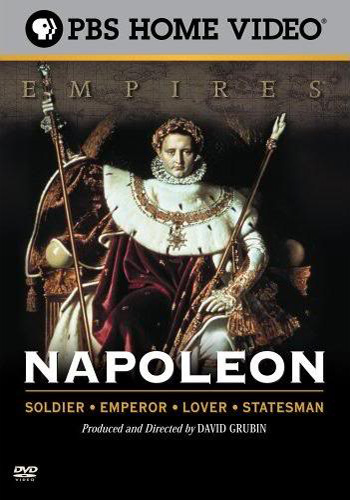
PBS Napoleon


NAPOLEON premiered on PBS in November 2000, narrated by David Mccullough.

1. To Destiny

Episode I recounts the story of Napoleon's extraordinary rise from Corsican obscurity to the victories in Italy that made him a hero to the French people and convinced him that he was destined for greatness. It also tells of his love for Josephine Beauharnais, a woman of extravagant habits and tastes, who did not at first return his passionate affection.

2. Mastering Luck

Episode II charts Napoleon's ascent to absolute power, from victorious General to first Consul to Emperor of France. It describes his extraordinary achievements – from the Napoleonic Code and the Bank of France, to bridges, roads, and canals – as well as the tyrannical nature of his rule and the violent opposition of most of Europe.

3. The Summit of Ambition

Episode III witnesses Napoleon conquer most of Europe in a series of brilliant triumphs, including his legendary victory at the Battle of Austerlitz. To sustain his rule, he must keep fighting. But when he invades Spain, he has begun to reach too far.

4. The End

Episode IV describes Napoleon's downfall, including the invasion and subsequent retreat from Russia, and his final battles, in which all of Europe is arrayed against him. Exiled to Elba, he returns to France after just ten months, only to be defeated for the last time at Waterloo. Napoleon spends his final days exiled on an island far out in the Atlantic, where he writes his memoirs and reinvents his legend.

Tuesday, January 11, 2011

Bill Bryson - At Home: A Short History of Private Life


AT HOME: A Short History of Private Life 

Random House

[Houses aren't refuges from history. They are where history ends up.]

"Bill Bryson and his family live in a Victorian parsonage in a part of England where nothing of any great significance has happened since the Romans decamped. Yet one day, he began to consider how very little he knew about the ordinary things of life as he found it in that comfortable home. To remedy this, he formed the idea of journeying about his house from room to room to "write a history of the world without leaving home." The bathroom provides the occasion for a history of hygiene; the bedroom, sex, death, and sleep; the kitchen, nutrition and the spice trade; and so on, as Bryson shows how each has figured in the evolution of private life. Whatever happens in the world, he demonstrates, ends up in our house, in the paint and the pipes and the pillows and every item of furniture."


At Bryson's House, 'Home' Is Where The History Is
NPR Morning Edition, October 5, 2010

Monday, January 10, 2011

The Sandman - Vertigo Comics


The Sandman is a comic book series written by Neil Gaiman and published by DC Comics. Beginning with issue #47, it was placed under the imprint Vertigo. It chronicles the adventures of Dream of The Endless, who rules over the world of dreams, in 75 issues. It was published from 1989 until 1996. Gaiman's contract stipulated that the series would end when he left it.


The Sandman was one of Vertigo's flagship titles, and is available as a series of ten trade paperbacks. It has also been reprinted in a recolored four-volume Absolute hardcover edition with slipcase. Critically acclaimed, The Sandman was the only comic to ever win the World Fantasy Award, and is one of the few comic books ever to be on the New York Times Best Seller list, along with Watchmen and The Dark Knight Returns. It was one of five comics to make Entertainment Weekly's "100 best reads from 1983 to 2008", ranking at 46. Norman Mailer described the series as "a comic book for intellectuals."


The Sandman's main character is Dream, the Lord of Dreams, who is essentially the anthropomorphic personification of dreams. The storylines primarily take place in the Dreaming, Morpheus's realm, and the waking world, with occasional visits to other domains, such as Hell, Faerie, Asgard, and the domains of the other Endless. 

The Sandman was initially published as a monthly serial, in 32-page comic books (with some exceptions to this pattern). As the series quickly increased in popularity, DC Comics began to reprint them in hardcover and paperback editions, each representing either a complete novel or a collection of related short stories.

DC first published "The Doll's House" storyline in a collection called simply The Sandman. Shortly thereafter, the first three volumes were published and named independently and also collected in an eponymous boxed set.

Seasons of Mists

The issues in the collection first appeared in 1990 and 1991. The collection first appeared in paperback and hardback in 1992. The title is the opening phrase of John Keats' "Ode to Autumn".

It introduces Endless siblings Destiny and Delirium, and features Thor, Odin and Loki from Norse mythology; Anubis and Bast from Egyptian mythology; Susanoo-no-mikoto from Japanese mythology; Lucifer and the Angels Duma and Remiel from Christianity; Shivering Jemmy, a Lord of Chaos with the body of a child and the mind of a monster; Kilderkin, a Lord of Order who takes the form of a cardboard box, and the fairies Cluracan and Nuala, who will play important roles in later stories. Season of Mists marks the introduction of the Norse gods for the first time in the series.


Season of Mists is the first appearance of one of the central themes of the series, that of rules and responsibilities and whether we can lay them down. The gathering of the Endless family which opens the book makes the second reference to the "prodigal", an Endless sibling who abandoned his realm and responsibilities. The family gathering leads to Dream deciding that he must return to the underworld to right a wrong he committed, an event which triggers a major plot arc throughout the series.

Morpheus leaves his realm to travel to the underworld, where he imprisoned his former lover Nada, to release her. Having previously departed the realm with it very angry with him (in the first collection, Preludes and Nocturnes), Morpheus is apprehensive about the task. He sets about it, wanting to do what is right, but prepared for a confrontation which he knows he may lose.


Vertigo - DC Comics

Vertigo is an imprint of the American comic-book publisher DC Comics. Its books are marketed to a late-teen and adult audience, and may contain graphic violence, substance abuse, frank (but not explicit) depictions of sexuality, profanity, and controversial subjects. Although many of its releases are in the horror and fantasy genres, it also publishes works dealing with crime, social satire, speculative fiction, and biography. Each issue's cover carries the advisory label "Suggested for mature readers" (regardless of a specific issue's content). As of 2010, Karen Berger is the executive editor of the imprint, and has overseen it since its inception in 1993.


Vertigo comics series have won the comics industry's Eisner Award, including the Best Continuing Series of various years (Sandman, Preacher, 100 Bullets and Fables). Several of its publications have been adapted to film, including Hellblazer, A History of Violence, Stardust, and V for Vendetta.


Long-running titles

Hellblazer (274 issues to date)
Swamp Thing Vol.2 (171 issues)
100 Bullets (100 issues)
Fables (100 issues to date)
Animal Man (89 issues)
Doom Patrol Vol.2 (87 issues)
The Sandman (75 issues)
The Books of Magic (75 issues plus sequel series)
Lucifer (75 issues)
Sandman Mystery Theatre (70 issues)
Shade, the Changing Man (70 issues)
Preacher (66 issues plus tie-ins)
Transmetropolitan (60 issues)
The Dreaming (60 issues)
Y: The Last Man (60 issues)
DMZ (comics) (60 issues)
The Invisibles (59 issues over three volumes)


"I'm not blessed, or merciful. I'm just me. I've got a job to do, and I do it. Listen: even as we're talking, I'm there for old and young, innocent and guilty, those who die together and those who die alone. I'm in cars and boats and planes; in hospitals and forests and abbatoirs. For some folks death is a release, and for others death is an abomination, a terrible thing. But in the end, I'm there for all of them."
Death, talking about herself, in Dream Country.


Sunday, November 28, 2010

Kanye West: Runaway [My Beautiful Dark Twisted Fantasy]


Kanye West
My Beautiful Dark Twisted Fantasy
Rolling Stone - 5 Stars

"My Beautiful Dark Twisted Fantasy is his most maniacally inspired music yet, coasting on heroic levels of dementia, pimping on top of Mount Olympus."

Runaway
Runaway is a 35-minute long, short film directed by Kanye West. It serves as the music video for the song of the same name. The film depicts a romantic relationship between a man and a half-woman, half-phoenix, and is set to music by Kanye West, most of which is from his album My Beautiful Dark Twisted Fantasy.

It was filmed in Prague over the period of four days in the summer of 2010. West describes the video as an "overall representation of what he dreams and a parallel to his music career". According to model Selita Ebanks, who co-stars in the video, the moral is, "the world doesn't accept, or they try to change, what is different, instead of trying to understand it." On a personal note, I totally agree with that sentiment. Bill

Tuesday, October 19, 2010

The Pacific Century (1992)


The Pacific Century was a 1992 PBS Emmy Award winning ten part documentary series narrated by Peter Coyote about the rise of the Pacific Rim economies. Alex Gibney was the writer for the series, and Frank Gibney, his father, wrote the companion volume, The Pacific Century: America and Asia in a Changing World. The series was a co-production of the Pacific Basin Institute and KCTS-TV in Seattle.

Episodes:

1. The Two Coasts of China: Asia and the Challenge of the West
2. The Meiji Revolution
3. From the Barrel of a Gun
4. Writers and Revolutionaries
5. Reinventing Japan
6. Inside Japan, Inc.
7. Big Business and the Ghost of Confucius
8. The Fight for Democracy
9. Sentimental Imperialists: America in Asia
10. The Pacific Century: The Future of the Pacific Basin

Tuesday, October 12, 2010

Frontline: God In America


Frontline: God In America, 6 hours over 3 nights, Oct 11-13, 2010

Since the days when the Puritan "city on a hill" beckoned on the horizon of the New World, religious faith and belief have forged America's ideals, molded its identity and shaped its sense of mission at home and abroad.

For the first time on television, God in America explores the tumultuous 400-year history of the intersection of religion and public life in America, from the first European settlements to the 2008 presidential election. A co-production of AMERICAN EXPERIENCE and FRONTLINE, this six-hour series examines how religious dissidents helped shape the American concept of religious liberty and the controversial evolution of that ideal in the nation's courts and political arena; how religious freedom and waves of new immigrants and religious revivals fueled competition in the religious marketplace; how movements for social reform -- from abolition to civil rights -- galvanized men and women to put their faith into political action; and how religious faith influenced conflicts from the American Revolution to the Cold War.


Watch the full episode. See more FRONTLINE.

IMAX Cosmic Voyage

From the IMAX Film Powers of Ten. This part seems inspired by the film Powers of Ten by Charles & Ray Eames.

Monday, October 04, 2010

BBC Planet Earth


Planet Earth is a 2006 television series produced by the BBC Natural History Unit narrated by David Attenborough. Five years in the making, it was the most expensive nature documentary series by the BBC, and also the first to be filmed in high definition. The series was co-produced by the Discovery Channel and NHK in association with CBC, and was described by its makers as "the definitive look at the diversity of our planet".

Planet Earth was first broadcast in the United Kingdom on BBC One in March 2006, and premiered one year later in the USA on the Discovery Channel. By June 2007, it had been shown in 130 countries worldwide. For Discovery Sigourney Weaver's voiceover replaced Attenborough.

The series comprises eleven episodes, each of which features a global overview of a different habitat on Earth.

Episodes

1. From Pole to Pole
2. Mountains
3. Fresh Water
4. Caves
5. Deserts
6. Ice Worlds
7. Great Plains
8. Jungles
9. Shallow Seas
10. Seasonal Forests
11. Ocean Deep


Friday, August 13, 2010

BBC Yellowstone


Yellowstone is a BBC nature documentary series broadcast from 15 March 2009. Narrated by Peter Firth, the series takes a look at a year in the life of Yellowstone National Park, examining how its wildlife adapts to living in one of the harshest wildernesses on Earth.

Episodes:

1. "Winter"
2. "Summer"
3. "Autumn"

Its been described the series as "amazingly shot" and a "work of art". The Times gave it five out of five, and TV Scoop described it as "majestic yet understated and consistently surprising". At the 2009 Jackson Hole Wildlife Film Festival, Yellowstone gained the Best Series Award, and "Winter" gained the Best Wildlife Habitat Program award. It was also a finalist in the Best Cinematography category. At the 2009 International Wildlife Film Festival Awards, the series won the Best Cinematography and Best Ecosystem awards, and gained Merit Awards for Editing and Sound Design. 


Cosmos: Evolution

Carl Sagan's Cosmos: Evolution


Carl Sagan 1934 - 1996

Wednesday, August 11, 2010

WGBH Forum Network: Origin and Evolution of Life on Earth I

Origin and Evolution of Life on Earth I
WGBH Forum Network
October 5, 2005
Lynn Rothschild astrobiologist, NASA

video platformvideo managementvideo solutionsvideo player

Japanese Language: Kanji, Hiragana, Katakana

The Japanese writing system uses three main types of characters, the Kanji, Hiragana and Katakana.

The Kanji: traditional symbolic characters that originated in China.


Kyōiku Kanji

The Kyōiku kanji ("education kanji") are 1006 characters that Japanese children learn in elementary school. The number was 881 until 1981.

Jōyō Kanji

The Jōyō kanji are 1,945 characters consisting of all the Kyōiku kanji, plus an additional 939 kanji taught in junior high and high school. The Jōyō kanji were introduced in 1981. They replaced an older list of 1,850 characters known as the General-use kanji (tōyō kanji) introduced in 1946.

The Kanas:

Each kana is either a vowel such as "a" (あ); a consonant followed by a vowel such as "ka" (か); or "n" (ん).

Hiragana: 46 phonetic syllables used for native Japanese words.

Hiragana (read top down right to left, starting on the top right with 'A')


Katakana: 46 phonetic syllables used for foreign words.

Katakana (read top down right to left, starting on the top right with 'A')

I've lived in Japan for about 13 years, and the nice things about Japanese is that it is a phonetic language and easy to pronounce. It was quite easy to learn Hiragana and Katakana very quickly from the beginning. Kanji took quite a bit longer and never will be good enough, but makes a lot of sense after all this time. Kanji is mostly used for nouns and the root of verbs. Hiragana is used for particles, the suffix of nouns, verbs, adverbs and adjectives. Katakana although used for foreign words can be difficult because you can't assume the language from which the word was derived from. For example the Japanese word for bread パン (pan in Katakana) is actually the French word for bread.

To get a decent grasp of Japanese grammer, both colloquial and literal Japanese need a lot of practical usage. Below are some good books I've used as guides to help me along the way.  


Study References: (Although these are Kodansha books, I'm not promoting Kodansha, but these are the ones that have been most useful and practical for me over the years)

Kodansha’s Furigana Japanese-English Dictionary
This is an excellent dictionary. It has Kanji and Furigana. Romanized (Alphabet) dictionaries in alphabetical order (vs. the Japanese order that the Kanas are listed in) may be easy from a western perspective, but doesn't help much in getting used to the order of the kanas and the kanji in the same way Japanese do. In short dictionary uses their order, not ours.

Furigana refers to the small kana that are printed above or alongside kanji to show the pronunciation of the Chinese characters. They are common in children's books and comics to assist them as they learn the kanji. With furigana superscripts, the beginner who is familiar with hiragana and katakana is able to read even the most difficult and obscure kanji at a glance. Most books provide little or no guide to kanji readings or romanize some or all the Japanese words and sentences. This book also has full sentence examples to support the word definitions provided (also in Furigana).

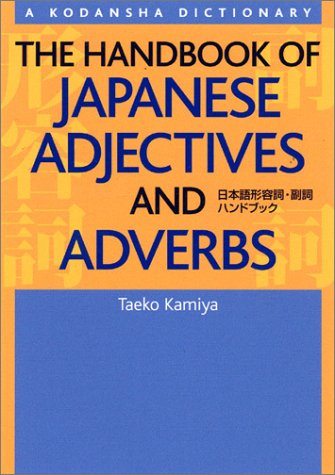
The Handbook of Japanese Adjectives and Adverbs
One thing I've struggled with is verbs, adverbs and adjectives. Unlike English there aren't many irregular verbs. If you know the root verb, then it is quite easy to conjugate it appropriately. So the challenge is not in the conjugation but the broader sentence structure. It took a while to grasp this and the book as well, but it includes an addendum that show the many sentence compounds along with the meaning they convey.

For any beginner of Japanese, adjectives and adverbs are bound to present a challenge. Unlike English adjectives, Japanese ones conjugate, meaning that you must memorize their various forms before being able to build sentences of any complexity. Adverbs do not conjugate, but make use of particles to show their grammatical relationship to other words, and some have very subtle shades of meaning that are difficult to grasp. Moreover, many adverbs do not translate into English adverbs. The role these parts of speech play in adding flavor to the Japanese language is invaluable. This handy reference manual introduces the basic (and basics of) adjectives and adverbs in a clear and sensible way.

A Dictionary of Japanese Particles
As I mentioned earlier, hiragana is used as particles within a sentence. This book is invaluable to how to communicate clear and concisely. It would be like trying to speak English without 'the, a, an, or, at, on, of...' Japanese as a phonetic language has many more particles than English. Although phonetically and literally simplistic, it is the particles that give the Japanese language flexibility, expressiveness, and depth.

For English-speaking students of Japanese, particles are perhaps the most difficult aspect of the language to learn. It would be no exaggeration to say that, for most people, they can never be completely mastered. Thus, the study of particles is a lifetime undertaking, and students need a lifelong companion to help them along the way. This dictionary covers over 100 particles in alphabetical order, explains the meanings of each (most have more than one), and gives sample sentences for each meaning.