Sunday, December 02, 2012

This American Life 479: Little War on the Prairie


This American Life: Little War on the Prairie
November 23, 2012

Growing up in Mankato, Minnesota, John Biewen says, nobody ever talked about the most important historical event ever to happen there: in 1862, it was the site of the largest mass execution in U.S. history. Thirty-eight Dakota Indians were hanged after a war with white settlers. John went back to Minnesota to figure out what really happened 150 years ago, and why Minnesotans didn’t talk about it much after.


Prologue

Ira talks to John Biewen about how remarkable it is that he could grow up in a town and never learn about the most significant event in its history. This show about Native Americans and settlers was first broadcast on Thanksgiving weekend, on the 150th anniversary of the war. (4 minutes)

Act One

John meets up with Gwen Westerman, a Dakota woman who moved to Mankato twenty years ago, also having no idea about its history. Together they travel to historic sites across Minnesota, reconstructing the story of what led to the war between the Dakota and the settlers. (25 minutes)

Act Two

John continues the story of the Dakota War of 1862, and how it resulted in the expulsion of the Dakota people from the state of Minnesota. Then John goes back to his hometown to see how this history is being taught today. He speaks with historian Mary Wingerd, author of North Country: The Making of Minnesota, about why so many people — including both of them — grew up in Minnesota and heard so little about the war. And he witnesses Dakota people, on the 150th anniversary of the war, crossing the state line and returning to Minnesota. (26 minutes)

Wednesday, November 21, 2012

A Sort of Homecoming


Time in my life when radical change is on the horizon, this song always makes sense to me.


And you know it's time to go
Through the sleet and driving snow
Across the fields of mourning
Light in the distance

And you hunger for the time
Time to heal, desire, time
And your earth moves beneath
Your own dream landscape

Oh, oh, oh...
On borderland we run...

I'll be there
I'll be there...
Tonight
A high road
A high road out from here

The city walls are all pulled down
The dust, a smoke screen all around
See faces ploughed like fields that once
Gave no resistance

And we live by the side of the road
On the side of a hill 
As the valley explode
Dislocated, suffocated
The land grows weary of it's own

Oh, oh, oh...on borderland we run...
And still we run
We run and don't look back
I'll be there
I'll be there
Tonight
Tonight

I'll be there tonight...I believe
I'll be there...somehow
I'll be there...tonight
Tonight

The wind will crack in winter time
This bomb-blast lightning waltz
No spoken words, just a scream...

Tonight we'll build a bridge 
Across the sea and land
See the sky, the burning rain
She will die and live again
Tonight

And your heart beats so slow
Through the rain and fallen snow
Across the fields of mourning
Light's in the distance

Oh don't sorrow, no don't weep
For tonight, at last
I am coming home
I am coming home

Wednesday, September 19, 2012

Frontline - The Battle for Syria


In Frontline's two-part special report broadcast Sep 18 2012, The Battle for Syria, FRONTLINE journeys to the heart of the Syrian insurgency, embedding with rebels who are waging a full-scale assault on Assad’s forces. But how organized are Syria’s opposition groups? What dangers might the conflict unleash? And what would it take to end it?

FRONTLINE turned to 10 experts — Syrian activists, journalists who have reported from the country’s dangerous front lines and analysts who specialize in the region — to explain the long-term impacts of Syria’s deadly conflict.

Part 1 - The Battle for Syria


Watch The Battle for Syria on PBS. See more from FRONTLINE.

Part 2 - The Regime Responds


Watch The Regime Responds on PBS. See more from FRONTLINE.

Tuesday, September 18, 2012

American Experience - Jimmy Carter


Jimmy Carter's story is one of the greatest dramas in American politics. In 1980, he was overwhelmingly voted out of office in a humiliating defeat. Over the subsequent two decades, he became one of the most admired statesmen and humanitarians in America and the world. Jimmy Carter, part of AMERICAN EXPERIENCE’s award-winning Presidents series, traces his rapid ascent in politics, dramatic fall from grace and unexpected resurrection.


Monday, September 10, 2012

Tokyo Mizube Line Water Bus Transportation


The Tokyo Mizube Line is water-bus transportation service, which navigates around the Sumida and the Arakawa rivers, Odaiba area and Kasai Rinkai Park. Other than general transportation service, they have many kinds of special cruising to enjoy Japanese events such as cherry blossom viewing in Spring and fireworks in Summer.

Himiko Interior
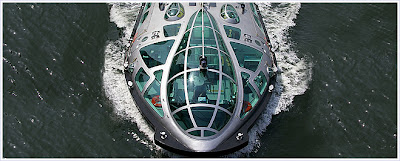
The Water Bus “Himiko” Produced by Leiji Matsumoto,one of the best renowned Japanese cartoonists.   “Himiko” is a completely unique water bus with its streamline shaped body with large windows. Himiko is named after Queen Himiko who was the first recognized independent lady in Japanese history.

Himiko Routes
Himiko runs from Asakusa to Odaiba Seaside Park, to Toyosu and then back to Asakusa. During the daytime the futuristic ship runs through old Edo and modern Tokyo while enjoying 360-degree panoramic view. At night the floor panels are lit up and emphasize the ship’s sophisticated design.

Hotaluna Cruise
Himiko has a promenade deck to enjoy the scenery outside the ship. At night the Hotaluna Cruise lights up the back of the window glass on the rear ship emitting a pale light emitted during evening and night, so that it lights up like a firefly. The name Hotaluna is a combination of  Hotaru  the Japanese word for 'firefly', and Luna the latin goddess of the moon. Reiji Matsumoto designed and named Hotaluna to represent a firefly shining mysteriously at night under the moon while travelling across the Sumida River".


Thursday, September 06, 2012

Why We Fight - 2006 Documentary Film


Why We Fight is 2006 Documentary film by Eugene Jarecki about the "military–industrial complex". The title refers to the World War II-era eponymous propaganda movies commissioned by the U.S. Government to justify their decision to enter the war against the Axis Powers. It describes the rise and maintenance of the United States military–industrial complex and its 50-year involvement with the wars led by the United States to date, especially its 2003 Invasion of Iraq. The documentary asserts that in every decade since World War II, the American public was misled so that the government (incumbent Administration) could take them to war and fuel the military-industrial economy maintaining American political dominance in the world.

Film below but no sound, need to turn on CC, or download via bitTorrent.

Tuesday, July 31, 2012

Mars Science Laboratory and Curiosity Rover

The MSL robotic mission to Mars will attempt to land a Mars rover called Curiosity on the surface of Mars, scheduled to land in Gale Crater on August 6, 2012. The rover's objectives include determining Mars' habitability, studying the Martian climate and geology, and collecting data for a future manned mission to Mars.

MSL Launch
The rover was launched from an Atlas V rocket from Cape Canaveral on November 26, 2011. 
The MSL mission has four scientific goals:
  • Determine whether Mars could ever have supported life
  • Study the climate of Mars
  • Study the geology of Mars
  • Plan for a human mission to Mars

Landing a large mass on Mars is a difficult challenge. The atmosphere is thick enough to prevent rockets being used to provide significant deceleration, as flying into the plume at supersonic speed is notoriously unstable. Also, the atmosphere is too thin for parachutes and aerobraking alone to be effective. The landing sequence alone requires six vehicle configurations, 76 pyrotechnic devices, the largest supersonic parachute ever built, and more than 500,000 lines of code.


The spacecraft will employ several systems in a precise order, where the entry, descent and landing sequence will break down into four parts.

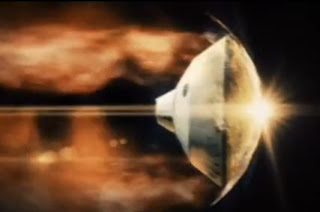
1. Guided entry: The rover is folded up within an aeroshell which protects it during the travel through space and during the atmospheric entry at Mars. Atmospheric entry is accomplished using a phenolic impregnated carbon ablator heat shield. The 4.5 m (15 ft) diameter heat shield, which will be the largest heat shield ever flown in space, reduces the velocity of the spacecraft by ablation against the Martian atmosphere, from the atmospheric interface velocity of approximately 5.8 km/s (3.6 mi/s) down to approximately 470 m/s (1,500 ft/s), where parachute deployment is possible about four minutes later. 


2. Parachute Descent: When the entry phase is complete and the capsule has slowed to Mach 2 and at about 10 km (6.2 mi) altitude, the Mars Science Laboratory will then deploy a supersonic parachute, as was done by previous landers such as Viking, Mars Pathfinder and the Mars Exploration Rovers. 

3. Powered Descent: Following the parachute braking, at about 1.8 km (1.1 mi) altitude, still travelling at about 100 m/s (220 mph), the rover and descent stage drop out of the aeroshell. The descent stage is a platform above the rover with 8 variable thrust mono propellant hydrazine rocket thrusters on arms extending around this platform to slow the descent. 

4. Sky Crane: To prevent the retrorockets from forming a dust cloud that could damage the rover's instruments, the sky crane system will lower the rover with a 65 foot tether to a soft landing, wheels down on the surface of Mars.


NASA's Seven Minutes of Terror: Curiosity's precarious Mars landing explained (video)

Thursday, July 26, 2012

American Experience: Jesse Owens


"The most famous athlete of his time, his stunning triumph at the 1936 Olympic Games captivated the world even as it infuriated the Nazis. Despite the racial slurs he endured, Jesse Owens' grace and athleticism rallied crowds across the globe. But when the four-time Olympic gold medalist returned home, he could not even ride in the front of a bus. The story of the 22-year-old son of a sharecropper who triumphed over adversity to become a hero and world champion, Jesse Owens is also about the elusive, fleeting quality of fame and the way Americans idolize athletes when they suit our purpose, and forget them once they don't." pbs.org

Monday, June 25, 2012

This American Life: Americans in China


This American Life 467: Americans in China

It used to be that the American expats in China were the big shots. They had the money, the status, the know-how. But that's changed. What's it like to be an American living in China now? And what do they understand about China that we don't?

Act One: Why do you have to go and make things so complicated?
Act Two: Beautiful Downtown Wasteland.

Thursday, May 10, 2012


Money, Power and Wall Street
4 hours broadcast on April 24 and May 1 2012, Frontline tells the inside story of the global financial crisis.

The Obama administration arrived in Washington in early 2009 facing the worst financial crisis since the Great Depression - and an American public outraged by bailouts for the financial institutions that had gotten them there. Money, Power and Wall Street gives an inside look at how the Obama administration, including a divided economic team, has handled the crisis and how the financial world has returned to many of the practices that created the meltdown in the first place.

Tuesday, April 24, 2012

Edo Tokyo Museum


The Edo-Tokyo Museum (江戸東京博物館) is a museum of the history of Tokyo, established in 1993. The main features of the permanent exhibitions are the life-size replica of the Nihonbashi which was the bridge leading into Edo; the Nakamuraza theatre; scale models of town; and buildings from the Edo, Meiji and Shōwa periods.

The original "Golden Mask" of the Tower of the Sun" 
By Taro Okamoto
The Edo-Tokyo Museum was designed by Kiyonori Kikutake. The distinctive elevated shape of the museum building is modelled after an old storehouse in the kurazukuri style.

Ukiyo-e "woodblock print" painting process
Walking through the Museum is like travelling from the Edo of past centuries into the modern Tokyo of today.


Edo (江戸, literally "bay-entrance" or "estuary"), is the former name of Tokyo. It was the seat of power for the Tokugawa shogunate, which ruled Japan from 1603 to 1868. During this period it grew to become one of the largest cities in the world and home to an urban culture centered on the notion of a "floating world". 
Nihonbashi in Edo, Ukiyo-e by Hiroshige
The city was laid out as a castle town around Edo Castle. The Sumida River (then called the Great River, 大川), ran along the eastern edge of the city. The Edo Bridge (江戸橋) marked the center of the city's commercial center. The northeastern corner of the city is guarded from evil by a number of temples (including Sensō-ji and Kan'ei-ji).
Edo Castle Wall
Edo Castle (江戸城), also known as Chiyoda Castle (千代田城), is a flatland castle that was built in 1457 by Ōta Dōkan. It is located in Chiyoda in Tokyo, then known as Edo. It was the residence of the shogun and location of the shogunate, and also functioned as the military capital during the Edo period of Japanese history.
Aerial view of the Imperial Ground 
When the shogun departed and the Meiji Restoration it became the Tokyo Imperial Palace. Some moats, walls and ramparts of the castle survive to this day. However, the grounds were more extensive during the Edo period, with Tokyo Station and the Marunouchi section of the city lying within the outermost moat. It also encompassed Kitanomaru Park, the Nippon Budokan Hall and other landmarks of the surrounding area.


Wednesday, March 14, 2012

Japan Rail Network - Greater Tokyo

Combined Tokyo Metro Rail Lines - Japan Rail plus Subway
The Tokyo Metro region is a megalopolis of over 30 Million people. Rail is the primary mode of transportation, which has the most extensive subway network in the world and an equally extensive network of surface lines.

JR East Railway Lines in Greater Tokyo
JR East operates Tokyo's largest railway network, including the Yamanote Line loop that circles the center of downtown Tokyo. The stations on the Yamanote Line are some of the most expensive in Tokyo due to the convenience it offers and all the commercial development that takes place around its stations.

Yamanote Line Route (Green)
It is estimated some 20 million people use rail as their primary means of transport (not trips) in the metropolitan area daily. In comparison, the entire country of Germany, with the highest per-capita railway use in Europe, has 10 million daily train riders.

Busiest stations

Passengers carried in Greater Tokyo stations daily (as of 2007):
  1. Shinjuku Station 3.64 million
  2. Ikebukuro Station 2.71 million
  3. Shibuya Station 2.18 million
  4. Yokohama Station 2.09 million
  5. Tokyo Station 1.12 million
  6. Shinagawa Station 0.91 million
  7. Takadanobaba Stn 0.90 million
  8. Shimbashi Station 0.85 million
Tokyo Subway System (Metro and Toei subway lines combined)
Two organizations operate the subway network: the private Tokyo Metro and the governmental Tokyo Metropolitan Bureau of Transportation.

There are 882 interconnected rail stations in the Tokyo Metropolis, 282 of which are Subway stations, with several hundred more in each of the 3 surrounding suburban prefectures. There are 30 operators running 121 passenger rail lines (102 serving Tokyo and 19 more serving Greater Tokyo but not Tokyo's city center itself), excluding about 12 cable cars.

Despite this vastness, the network is still being expanded, albeit with more service upgrades and fewer new lines. Each of the region's rail companies makes their own maps, with key transfer points highlighted. Trains are often extremely crowded at peak travel times, with people being pushed into trains by so-called oshiya ("pushers").


Most lines in Tokyo are privately owned and operated, though the Toei Subway is run directly by the Tokyo Metropolitan Government and Tokyo Metro is owned indirectly by the Tokyo and national governments. Rail and subway lines are highly integrated and dense; commuter trains from the suburbs continue directly into the subway network on many lines, often emerging on the other side of the city to serve another company's surface commuter line. Shinjuku Station is the busiest train station in the world by passenger throughput.


This American Life: What Kind of Country is This?


This American Life #459: What Kind of Country?

All across the country right now, local and state governments are finding they can't pay their bills. Schools are losing teachers, street lights are going dark, garbage is piling up in public parks, and cops are suddenly an optional expense. Is this the kind of country we want? One where government gets smaller? Or should we all pay higher taxes, and keep government bigger?

Tuesday, February 28, 2012

Frontline: Inside Japan's Nuclear Meltdown


Retrospective film almost a year after a tsunami crippled Japan's Fukushima power plant. How a small group of engineers, soldiers and firemen risked their own lives to prevent a complete nuclear meltdown.

Film “a gripping account of a series of potentially catastrophic developments in how the government, plant workers and citizens responded. Describing in detail the days after the earthquake and tsunami from rumors about evacuating Tokyo to a dangerous mission to vent one of the reactors and offers insight into what the workers were thinking during those uncertain hours.

One Year Later, 'Inside Japan's Nuclear Meltdown' (interview)
NPR Fresh Air
February 28, 2012


Frontline: Inside Japan's Nuclear Meltdown (film)
February 28, 2012


Japan Weighed Evacuating Tokyo in Nuclear Crisis
New York Times
February 27, 2012

Tuesday, February 21, 2012

American Experience: Clinton


The biography of a president who rose from a broken childhood in Arkansas to become one of the most successful politicians in modern American history, and one of the most complex and conflicted characters to ever stride across the public stage. From draft dodging to the Dayton Accords, from Monica Lewinsky to a balanced budget, the presidency of William Jefferson Clinton veered between sordid scandal and grand achievement. Clinton had a career full of accomplishment and rife with scandal, a marriage that would make history and create controversy, and a presidency that would define the crucial and transformative period between the fall of the Berlin Wall and 9-11.

The latest installment in the critically acclaimed and successful series of presidential biographies, Clinton follows the president across his two terms as he confronted some of the key forces that would shape the future, including partisan political warfare and domestic and international terrorism, and as he struggled with uneven success to define the role of American power in a post-Cold War world. Most memorably, it explores how Clinton’s conflicted character made history, even as it enraged his enemies and confounded his friends.

Tuesday, February 14, 2012

Slavery By Another Name


Slavery by Another Name is a 90-minute documentary that challenges one of Americans’ most cherished assumptions: the belief that slavery in this country ended with the Emancipation Proclamation. The film tells how even as chattel slavery came to an end in the South in 1865, thousands of African Americans were pulled back into forced labor with shocking force and brutality. It was a system in which men, often guilty of no crime at all, were arrested, compelled to work without pay, repeatedly bought and sold, and coerced to do the bidding of masters. Tolerated by both the North and South, forced labor lasted well into the 20th century.


Slavery by Another Name: The Re-Enslavement of Black American from the Civil War to World War II
By Douglas A. Blackmon

NPR Interview and book excerpt: Talk of the Nation March 25, 2008

Winner of the 2009 Pulitzer Prize for General Non-Fiction

Reveals how, from the late 1870s through the mid-twentieth century, thousands of African-American men were arrested and forced to work off outrageous fines by serving as unpaid labor to businesses and provincial farmers.

Thursday, February 02, 2012

The House I Live In - 2012 film


The House I Live In (2012)
Directed and written by Eugene Jarecki

2012 Sundance Film Festival Grand Jury Prize: Documentary

Documentary tracks the history of the U.S. War on Drugs. After 44 million arrests, sales of illegal drugs are still on the rise. the documentary argues that America's War on Drugs needs a drastic rethinking.

Sundance Film Festival 2012: Grand Jury Prizewinner Eugene Jarecki on Drug War Doc, 'The House I Live In'
Hollywood Reporter
January 29, 2012

"The House I Live In": New Documentary Exposes Economic, Moral Failure of U.S. War on Drugs
Democracy Now!
January 31, 2012


The House I Live In is also the name of a 1945 ten-minute short film starring Frank Sinatra. It was made to oppose anti-Semitism and racial prejudice at the end of World War II and received an Honorary Academy Award and a special Golden Globe award in 1946. In 2007, this film was selected for preservation in the United States National Film Registry by the Library of Congress as being "culturally, historically, or aesthetically significant".

The New Jim Crow: Mass Incarceration in the Age of Colorblindness


The New Jim Crow: Mass Incarceration in the Age of Colorblindness
By Michelle Alexander (2010)

Book that argues that the War on Drugs and policies that deny convicted felons equal access to employment, housing, education and public benefits create a permanent under-caste based largely on race.

NPR: Book Excerpt

Legal Scholar: Jim Crow Still Exists In America
NPR Fresh Air
January 16, 2012

Monday, January 09, 2012

Aretha Franklin: Amazing Grace


Amazing Grace is a 1972 album by Aretha Franklin. It ultimately sold over two million copies in the United States alone, earning a Double Platinum certification. As of 2011 it is still the biggest selling disc of Aretha's entire fifty year recording career. The double album was recorded 'Live' at the New Temple Missionary Baptist Church in Los Angeles during January 1972. It won the 1972 Grammy Award for Best Soul Gospel Performance and also stands as the biggest selling Gospel album in history. A film documenting the making of the album was set to be released in 1972, but was shelved by Warner Bros.


NPR WBUR: On Point With Tom Ashbrook

Aretha Franklin’s ‘Amazing Grace’

"When Aretha went back to gospel. “Queen of Soul” Aretha Franklin and her epic 1972 album, “Amazing Grace.”

January 13th, 1972.  Watts.  Los Angeles.  The New Temple Missionary Baptist Church was in a swivet.  Aretha Franklin was in the house.  The preacher’s daughter who had taken the pop world by storm, who had gone platinum secular superstar, had become the “Queen of Soul,” had come home to gospel.

Never mind “Chain of Fools” and “Respect” and “I never Loved a Man (The Way I Love You).  Tonight it was “Precious Lord”.  Tonight it was “Amazing Grace.”

This hour, On Point:  the Queen of Soul’s greatest recording.

-Tom Ashbrook"

Thursday, December 01, 2011

The Warmth of Other Suns


The Warmth of Other Suns: The Epic Story of America's Great Migration
By Isabel Wilkerson

NPR Fresh Air: Great Migration: The African-American Exodus North
September 13, 2010

"Between 1915 and 1970, more than 6 million African-Americans moved out of the South to cities across the Northeast, Midwest and West.

This relocation — called the Great Migration — resulted in massive demographic shifts across the United States. Between 1910 and 1930, cities such as New York, Chicago, Detroit and Cleveland saw their African-American populations grow by about 40 percent, and the number of African-Americans employed in industrial jobs nearly doubled."


NPR Books: 'Other Suns': When African-Americans Fled North
September 16, 2010

"Wilkerson, a Pulitzer Prize-winning journalist for the New York Times, has taken what many would consider an indigestible chunk of history — long and sometimes famously written about by earlier historians and sociologists — and given us an extraordinarily palatable narrative."


Thursday, November 10, 2011

Race Against the Machine


Race Against the Machine: How the Digital Revolution is Accelerating Innovation Driving Productivity, and Irreversibly Transforming Employment and the Economy
By Erik Brynjolfsson and Andrew McAfee

NPR’s On Point with Tom Ashbrook  (WBUR, Boston)
"When Machines do the Work”
November 2, 2011

Fora.tv: Compass Summit 2011


Race Against the Machine from Compass Summit on FORA.tv

Monday, November 07, 2011

Knocking on Heaven's Door - Lisa Randall


Knocking on Heaven's Door: How Physics and Scientific Thinking Illuminate the Universe and the Modern World
By Lisa Randall


Physicist Lisa Randall On Cosmology And The LHC
NPR Talk of the Nation, Science Friday
September 30, 2011

Harvard physicist Lisa Randall talks about her new book, Knocking On Heaven's Door, an examination of the latest findings in cosmology and the history of scientific thought, and discusses a report that suggests neutrinos can travel faster than the speed of light.

NOVA: Fabric of the Cosmos


The Fabric of the Cosmos

Acclaimed physicist Brian Greene reveals the reality beneath the surface of our everyday world.
Airing 11/2, 11/9, 11/16 and 11/23, at 9pm on PBS

Watch Online

Episode 1: What is Space?
Episode 2: The Illusion of Time
Episode 3: Quantum Leap
Episode 4: Universe or Multiverse

Brian Greene Explains 'The Fabric Of The Cosmos'
NPR Talk of the Nation, Science Friday
October 28, 2011


Wednesday, October 05, 2011

Prohibition by Ken Burns


"PROHIBITION is a three-part, five-and-a-half-hour documentary film series directed by Ken Burns and Lynn Novick that tells the story of the rise, rule, and fall of the Eighteenth Amendment to the U.S. Constitution and the entire era it encompassed.

Prohibition was intended to improve, even to ennoble, the lives of all Americans, to protect individuals, families, and society at large from the devastating effects of alcohol abuse. But the enshrining of a faith-driven moral code in the Constitution paradoxically caused millions of Americans to rethink their definition of morality.

Prohibition turned law-abiding citizens into criminals, made a mockery of the justice system, caused illicit drinking to seem glamorous and fun, encouraged neighborhood gangs to become national crime syndicates, permitted government officials to bend and sometimes even break the law, and fostered cynicism and hypocrisy that corroded the social contract all across the country."

Episodes:

Part 1 "A Nation of Drunkards" describes how immigration, alcoholism, women's suffrage and the temperance movements led up to the passing of the 18th Amendment, Prohibition.
Part 2 "A Nation of Scofflaws" addresses how the enforcement of Prohibition was inconsistent and caused unintended consequences, including making criminals of a large portion of the population.
Part 3 "A Nation of Hypocrites" follows the gradual swing towards repeal of Prohibition as the Great Depression focuses attention on other priorities.


Watch Prohibition Sneak Peek on PBS. See more from Ken Burns.

Friday, September 30, 2011

NOVA: Surviving the Tsunami, A film by NHK


Aired September 28, 2011 on PBS

"The earthquake that hit the northern coast of Japan on March 11, 2011 was recorded at magnitude 9.0. It generated an unprecedented tsunami, obliterating coastal villages and towns in a matter of minutes. In some areas, the tsunami climbed over 100 feet in height and traveled miles inland. Amazingly, amateur and professional photographers captured it all on video, including remarkable tales of human survival, as ordinary citizens became heroes in a drama they never could have imagined.
As the waves rush in, a daughter struggles to help her elderly mother ascend their rooftop to safety; a man climbs onto an overpass just as the wave overtakes his car. These never-before-seen stories are captured in video and retold after-the-fact by the survivors who reveal what they were thinking as they made their life-saving decisions. Their stories provide lessons on how we should all act in the face of life-threatening disasters. This unique program was originally produced and broadcast in Japan by NHK, Japan's public broadcaster."
Watch the full episode. See more NOVA.


Tuesday, August 30, 2011

BBC: First Life with David Attenborough


From the fog bound coastline of Newfoundland to the deserts of North Africa and the rainforests of Queensland, in BBC's First Life David Attenborough finds evidence in fossils and living animals of an extraordinary period in Earth’s history, half a billion years ago, when animals first appeared in the oceans. From the first eyes that saw, to the first predators that killed and the first legs that walked on land, these were creatures that evolved the traits and tools that allow all animals, including us, to survive to this day.

This is a story that can only be told now because in the last few years, stunning fossil finds at sites across the world have transformed our understanding of the first life forms, and the latest technology allows us to recreate the first animals and their environments with photo-realistic CGI.


Wednesday, July 27, 2011

Frontline: The Pot Republic


Frontline: The Pot Republic

A timely report from the frontlines of marijuana legalization in California. The bulk of the marijuana consumed in the United States used to come across the border from Mexico, Canada and elsewhere. Now, more than half of it is believed to be home grown in California, where an enormous black market has emerged under the cover of the state's medical marijuana law. With more than a third of all states now experimenting with some form of legalization and decriminalization -- and several California counties attempting to openly regulate pot production -- FRONTLINE and the Center for Investigative Reporting team up to investigate the country's oldest, largest and most wide-open marijuana market. Is the federal government now moving to shut it down?


Watch the full episode. See more FRONTLINE.

Frontline: The Atomic Artists


Frontline: The Atomic Artists
July 26, 2011

How one group of artists is challenging Japan's unusually strong faith in nuclear power

FRONTLINE journeys with Marco Werman of PRI's The World as he meets Chim-Pom, a provocative group of young artists making headlines as they use art to challenge the status quo in Japan.

"Japanese youth had generally been very apolitical and apathetic" before the March 2011 disaster, says The Atomic Artists producer Emily Taguchi. But things have changed dramatically since then. We talked with Taguchi about this shift, and how one group, the art collective Chim-Pom, is challenging the status quo with their controversial installations.


Watch the full episode. See more FRONTLINE.


Tuesday, July 12, 2011

Eaarth: Making a Life on a Tough New Planet


Eaarth: Making a Life on a Tough New Planet
Bill McKibben 2010

Twenty years ago, with The End of Nature, Bill McKibben offered one of the earliest warnings about global warming. Those warnings went mostly unheeded; now, he insists, we need to acknowledge that we've waited too long, and that massive change is not only unavoidable but already under way. Our old familiar globe is suddenly melting, drying, acidifying, flooding, and burning in ways that no human has ever seen. We've created, in very short order, a new planet, still recognizable but fundamentally different. We may as well call it Eaarth.

Scientific America Interviews (2 parts):
Scientific American Part 1 April 21, 2010
Scientific American Part 2 April 22, 2010

Dominican University Speech (Youtube):


Bill McKibben Speaks at The New School on Climate Change