Monday, April 28, 2008

Unforgivable Blackness (2004)


film description wikipedia.org:

"Unforgivable Blackness: The Rise and Fall of Jack Johnson is a documentary by filmmaker Ken Burns based on the nonfiction book of the same name by Geoffrey C. Ward (2004)."

Unforgivable Blackness @ PBS.org

download "Unforgivable Blackness" via bittorrent (requires bittorrent client)

Wednesday, March 26, 2008

Frontline: Bush's War


Frontline: Bush's War
PBS.org, Original Broadcast March 24 & 25, 2008


Watch the full episode. See more FRONTLINE.

Now, on the fifth anniversary of the Iraq invasion, the full saga unfolds in the two-part FRONTLINE special Bush's War. Veteran FRONTLINE producer Michael Kirk draws on one of the richest archives in broadcast journalism -- more than 40 FRONTLINE reports on Iraq and the war on terror. Combined with fresh reporting and new interviews, Bush's War will be the definitive documentary analysis of one of the most challenging periods in the nation's history.

"Parts of this history have been told before," Kirk says. "But no one has laid out the entire narrative to reveal in one epic story the scope and detail of how this war began and how it has been fought, both on the ground and deep inside the government."

Bush's War is the sixth in a series of Iraq war stories from FRONTLINE producer Michael Kirk, including Rumsfeld's War, The Torture Question, The Dark Side, The Lost Year in Iraq and
Endgame.

Monday, March 03, 2008

Gorée Senegal Diaspora


African Diaspora

The African diaspora was the movement of Africans and their descendants to places throughout the world such as the Americas, Europe, Asia, and Australia. Much of the African diaspora is descended from people who were enslaved and shipped to the Americas during the Atlantic slave trade, with the largest percentage sent to Brazil. Brazil obtained 37% of all African slaves traded, and more than 3 million slaves were sent to Brazil.

The Trans Atlantic Slave Trade

The Trans-Atlantic Slave trade resulted in a vast and as yet still unknown loss of life for African captives both in and outside of America. Approximately 8 million Africans were killed during their storage, shipment and initial landing in the New World. The amount of life lost in the actual procurement of slaves remains a mystery but may equal or exceed the amount actually enslaved. If such a figure is to be believed, the total number of deaths would be between 16 and 20 million. Most historians now agree that at least 12 million slaves left the continent between the fifteenth and nineteenth century, but 10 to 20% died on board ships. Thus a figure of 11 million slaves transported to the Americas is the nearest demonstrable figure historians can produce.


Goree Island, Dakar Senegal

Gorée is famous as a former center of the Atlantic slave trade from where many Africans were forcibly departed to the Americas. Gorée is a small island 900 m in length and 350 m in width sheltered by the Cape Vert Peninsula. Now part of the city of Dakar, it served for many centuries as one of the principal factories in the triangular trade between Africa, Europe and the Americas.


The House of Slaves

Gorée is best known as the location of the House of Slaves used as a holding and transfer point during the slave trade. The House of Slaves is one of the oldest houses on the island. The Door of No Return in the House of Slaves is said to be the final exit point of the slaves from Africa.


The House of Slaves is powerful, not because millions of slaves actually left through The Door of No Return, but because Africa's descendants have made this their place to honor them.


Descendent's of the Gorée Diaspora

The slaves from Gorée were destined essentially to the French colonies in the Caribbean (prominently Haiti) and in Louisiana, as well as to the Spanish colonies (Cuba essentially) and to the Portuguese colonies in Brazil. Very few African Americans from the U.S. have ancestors who went through Gorée, as the English colonists had other sources of "import" for their slaves. Those who can with most certainty consider Gorée as a transit point for their ancestors are the African Americans whose family are from the south of Louisiana, some of which actually still speak some sort of French. As African Americans have migrated a lot throughout the US in the last 100 years, it can be difficult to know with certainty which families were originally from French Louisiana.


Sunday, March 02, 2008

Africana: The Encyclopedia of the African and African-American Experience


Legendary scholar-activist W.E.B. Du Bois labored to complete an "Encyclopedia Africana" before his death in 1963. Just over 35 years later, two Harvard educators, Henry Louis Gates Jr. and Ghanaian-born Kwame Anthony Appiah, have brought Du Bois' intellectual dream to life in Africana, the most complete and comprehensive record of the Pan-African diaspora compiled into one volume.

The two Harvard professors have commissioned and condensed more than 3000 articles by more than 400 scholars. Though the bulk of the entries are devoted to the African continent and its descendant cultures in Latin America, the Caribbean and North America, the encyclopedia also addresses the African presence in Europe, Asia and the rest of the world.


Don't care where you come from
As long as you're a black man
You're an African

No mind your nationality
You have got the identity of an African

'Cause if you come from Clarendon
And if you come from Portland
And if you come from Westmoreland
You're an African

No mind your nationality
You've got the identity of an African

'Cause if you come Trinidad
And if you come from Nassau
And if you come from Cuba
You're an African

CHORUS
No mind your complexion
There is no rejection
You're an African

'Cause if your plexion High, High, High,
If your complexion low, low, low
And if your plexion in between
You're an African

No mind denomination
That is only segregation
You're an African

'Cause if you go to the Catholic
And if you go to the Methodist
And if you go to the Church of Gods
You're an African

No mind your nationality
You have got the identity of an African

Peter Tosh
African

Lose Your Mother: A Journey Along the Atlantic Slave Route


Lose Your Mother: A Journey Along the Atlantic Slave Route (Hardcover)
by Saidiya Hartman


Author Finds Heritage in Africa
News & Notes, January 23, 2007
npr.org

" As part of NPR's Crossing the Divide series, author Saidiya Hartman talks about one of the oldest and deepest divides in America: slavery. In Hartman's new book, Lose Your Mother: A Journey Along the Atlantic Slave Route, she returns to Ghana to do research, but instead finds personal transformation."


Amazon.com

"In this rousing narrative, Berkeley professor Hartman traces first-hand the progress of her ancestors-forced migrants from the Gold Coast-in order to illuminate the history of the Atlantic slave trade. Chronicling her time in Ghana following the overland slave route from the hinterland to the Atlantic, Hartman admits early on to a naïve search for her identity: "Secretly I wanted to belong somewhere or, at least, I wanted a convenient explanation of why I felt like a stranger." Fortunately, Hartman eschews the simplification of such a quest, finding that Africa's American expatriates often find themselves more lost than when they started.

Instead, Hartman channels her longing into facing tough questions, nagging self-doubt and the horrors of the Middle Passage in a fascinating, beautifully told history of those millions whose own histories were revoked in "the process by which lives were destroyed and slaves born." Shifting between past and present, Hartman also considers the "afterlife of slavery," revealing Africa-and, through her transitive experience, America-as yet unhealed by de-colonization and abolition, but showing signs of hope. Hartman's mix of history and memoir has the feel of a good novel, told with charm and passion, and should reach out to anyone contemplating the meaning of identity, belonging and homeland."


W.E.B Du Bois, 1868-1963
(W.E.B = William Edward Burghardt)

W.E.B Du Bois, Citizen of Ghana
wikipedia.com

"Du Bois was invited to Ghana in 1961 by President Kwame Nkrumah to direct the Encyclopedia Africana, a government production, and a long-held dream of his. When, in 1963, he was refused a new U.S. passport, he and his wife, Shirley Graham Du Bois, became citizens of Ghana, making him dual citizens of Ghana and the United States. Du Bois' health had declined in 1962, and on August 27, 1963, he died in Accra, Ghana at the age of ninety-five, one day before Martin Luther King, Jr.'s "I Have a Dream" speech."

Works by W.E.B. DuBois at Project Gutenberg:

“It is a peculiar sensation, this double-consciousness, this sense of always looking at one's self through the eyes of others, of measuring one's soul by the tape of a world that looks on in amused contempt and pity.” W. E. B. Du Bois

Sunday, February 10, 2008

Smile Please


A smiling face is an Earth like star
A frown can't bring out the beauty that you are
Love within and you'll begin smiling...
There are brighter days ahead

Don't mess your face up with bitter tears
'Cause life is gonna be what it is
It's okay, please don't delay from smiling...
There are brighter days ahead

A smiling face you don't have to see
'Cause it's as joyful as a Christmas tree
Love within and you'll begin smiling...
There're brighter days ahead

Love's not competing, it's on your side
You're in life's picture, so why must you cry?
So for a friend please begin to smile - Please
There are brighter days ahead

Bum,
Bum bum di ti bum,
Bum bum di ti bum,
Bum bum di ti bum

Please smile for me


Stevie Wonder
Fulfillingness First Finale
"Smile Please"


Thursday, January 03, 2008

WGBH (Great Blue Hill)


WGBH
is an established public television and public radio broadcast service located in Boston, Massachusetts. It operates over ten broadcasts: primarily WGBH 2 and WGBX 44 (television) and WGBH 89.7 FM (radio). WGBH is a member of PBS in regard to its television broadcasts, and both a member of NPR and an affiliate of PRI for its radio broadcasts. The license-holder is the WGBH Educational Foundation.

WGBH produces many shows for the above organizations, including nearly a third of PBS's national prime-time TV.

"GBH" stands for Great Blue Hill, the location of WGBH's FM transmitter, as well as the original location of WGBH-TV's transmitter. Great Blue Hill in Milton, Massachusetts, has an elevation of 635 feet (193 m) and is the highest point in the Boston area.


Blue Hill Ave.


WGBH Forum Network - Weekly Podcasts and New Downloads

Thursday, November 22, 2007

Thanksgiving


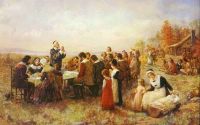
The Thanksgiving Story - wilstar.com

"The Pilgrims set ground at Plymouth Rock on December 11, 1620. Their first winter was devastating. At the beginning of the following fall, they had lost 46 of the original 102 who sailed on the Mayflower. But the harvest of 1621 was a bountiful one. And the remaining colonists decided to celebrate with a feast -- including 91 Indians who had helped the Pilgrims survive their first year."


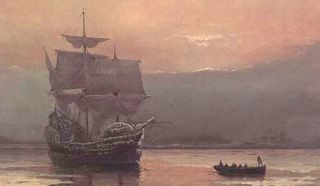
The Pilgrims

The Mayflower - en.wikipedia.org
The Mayflower was the ship which transported the Pilgrim Fathers from Plymouth, England to "North Virginia" (in what was later to become the United States of America) in 1620, leaving Plymouth on September 6 and dropping anchor near Cape Cod on November 11.

Plimouth Plantation - plimoth.org
A reconstruction of the 1627 village occupied by the Pilgrims.


The Native People


Blue Hill Ave.

Massachuset: Meaning ">at the range of hills," and meant the Blue Hills past Milton.

The Massachuset belonged to the Algonquian linguistic stock, their tongue being an n-dialect, and formed one group with the Narraganset, Niantic (East and West), and Wampanoag, and probably the Nauset.

In the region of Massachusetts Bay between Salem on the north and Marshfield and Brockton on the south. Later they claimed lands beyond Brockton as far as the Great Cedar Swamp, territories formerly under the control of the Wampanoag.

500 Nations - Massachusetts Tribes

Native Traditions in Massachusetts


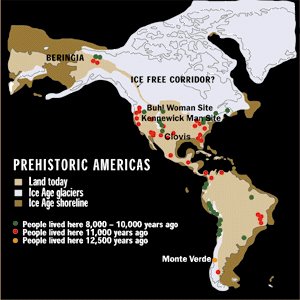
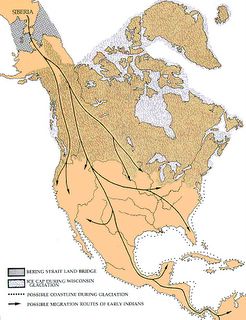
The Bering Strait Land Bridge and the Migration of Early Indians

Bering Strait Theory

"Most anthropologists today believe that the ancestors of all American Indians immigrated from northeastern Asia across the Bering land bridge during the Ice Age, between 12,000 and 60,000 years ago. Known as the Bering Strait theory, this idea is supported by archaeological, biological, and geological evidence."

Monday, October 29, 2007

Plane Ticket $350...


Plane Ticket: $350.
Game Ticket: $750.
The Yankees Watching the Sox in the World Series: PRICELESS.


Mountain men: Sox are champs
Boston rides four-game sweep to second title in four seasons

Wednesday, October 24, 2007

Frontline: Showdown With Iran


Showdown With Iran
10/23/2007


As the United States and Iran are locked in a battle for power and influence across the Middle East -- with the fear of an Iranian nuclear weapon looming in the background -- FRONTLINE gains unprecedented access to Iranian hard-liners shaping government policy, including parliament leader Hamid Reza Hajibabaei, National Security Council member Mohammad Jafari and state newspaper editor Hossein Shariatmadari.

Monday, October 15, 2007

Frontline: Cheney's Law


Cheney's Law
10/16/2007


Watch the full episode. See more FRONTLINE.

For three decades Vice President Dick Cheney conducted a secretive, behind-closed-doors campaign to give the president virtually unlimited wartime power. Finally, in the aftermath of 9/11, the Justice Department and the White House made a number of controversial legal decisions. Orchestrated by Cheney and his lawyer David Addington, the department interpreted executive power in an expansive and extraordinary way, granting President George W. Bush the power to detain, interrogate, torture, wiretap and spy -- without congressional approval or judicial review.

Sunday, October 14, 2007

Come On People - Bill Cosby & Alvin F. Poussaint


Entertainer Bill Cosby and Harvard Medical School Psychiatry Professor Dr. Alvin Poussaint tackle the controversial and complicated issues facing black communities across the nation and discuss their new book, "Come On, People: On the Path from Victims to Victors.

NBC Meet the Press Transcript
Meet the Press’ transcript for Oct. 14, 2007


Chapter 1

WHAT’ S GOING ON WITH BLACK PEOPLE?
For the last generation or two, as our communities dissolved and our parenting skills broke down, no one has suffered more than our young black people.

Your authors have been around long enough, and traveled widely enough, to think we understand something about the problem. And we’re hopeful enough—or desperate enough—to think that with all of us working together we might find our way to a solution. Let’s start with one very basic fact. Back in 1950, before Brown v. Board of Education, before the Civil Rights Act and the Voting Rights Act, when Rosa Parks was still sitting in the back of her Montgomery bus, when the NBA was just about all white, back in those troubled times, black boys were born into a different world than they are today. Obviously, many civil rights leaders had hoped that with the demise in the 1960s of officially sanctioned forms of segregation and discrimination, black males would have greater access to the mainstream of American society. They had fully expected that these young men would be in a better position in every way—financially, psychologically, legally—to sustain viable marriages and families. Instead, the overall situation has continued to go downhill among the poor who are mostly shut out from the mainstream of success.

How is that possible?

There is one statistic that captures the bleakness. In 1950, five out of every six black children were born into a two-parent home. Today, that number is less than two out of six. In poor communities, that number is lower still. There are whole blocks with scarcely a married couple, whole blocks without responsible males to watch out for wayward boys, whole neighborhoods in which little girls and boys come of age without seeing up close a committed partnership and perhaps never having attended a wedding.

Tuesday, October 02, 2007

How Can You Mend a Broken Heart?


I can think of younger days when living for my life
Was everything a man could want to do
I could never see tomorrow,
but I was never told about the sorrow

And how can you mend a broken heart?
How can you stop the rain from falling down?
How can you stop the sun from shining?
What makes the world go round?
How can you mend this broken man?
How can a loser ever win?
Please help me mend my broken heart and let me live again

I can still feel the breeze that rustles through the trees
And misty memories of days gone by
We could never see tomorrow,
No one said a word about the sorrow

And how can you mend a broken heart?
How can you stop the rain from falling down?
How can you stop the sun from shining?
What makes the world go round?
How can you mend this broken man?
How can a loser ever win?
Please help me mend my broken heart and let me live again

Al Green
How Can You Mend a Broken Heart?

Soultracks
VH1
Wikipedia


Sunday, August 26, 2007

Wind Blow '07 - Sagara Beach - Shizuoka Japan


Windblow '07

Sagara Beach in Shizuoka.
A 2-day music festival on the beach.


Latyr Sy / Africa Sunu Xelcom


Latry Sy was born in Island of Goreacutee, the Republic of Senegal and began to play African drums at the age of 10 years old. 1998, He formed the Traditional Percussion Band called "Africa Djembe" and played an active part as a soloist, a lead singer, a leader of the band. He performed in Nelson Mandela Concert, Island of Gorée international percussion Festival, African soccer Cup, 2002 World Soccer Cup as an supporter of the national team also welcome ceremonies off welcome Prime Minister Thatcher, President Mitterrand and other world class leaders and VIP.

1995, He formed another own percussion group called "Africa Sunu Xelcom". 1998, He performed for" the 100th anniversary of Cuban-Japanese Immigrant Memorial Event" and "International Jazz Festival" in Korea. 2000, He traveled around France, Germany, Egypt, and Korea to gives a performance in each place. 2001, He performed jointly with Noh comedian Mannojo Nomura in Smithsonian museum of Washington D.C. 2001, 2002, 2003, He appeared and performed in African Festa as "Africa Sunu Xelcom" 2005.


Inushiki (aka Dogggstyle)

"Inushiki" is the Rock Band born in the Kichijohji cultural area in 1998, with densed originality and its unique flavor. Never cared of the roots and color of easten or westen,and have carried "ANTITHESES" that shows the true presence of Rock Music to be so enegetic and omnivorous, which lays in the oposite side of Japanese Rock scene of now a days.

And the Spiritual resonance of "REBEL Music" such as Reggae and Punk has given them the devote to the bitter black Afro Rhythm. Have found the way to show the goal of flesh music that comes from thoughts and philosophy, and spits out the sensational MC which followed be the perfect balance of Lyric which alarts the awakening of one's self.And the undestoriable sound of band like a ROCK wraps the power of the wisdom, which never can be catagorise or give an example of what called "THE ORIGINAL SOUND" is only expressed as Progressive Rock or the Reggae Rock.

It's way to press their simple and honest Revolution and its primary impulse can't never gain or found in any other of its kind. From its speech and action, you can tell that they are the number ONE preacher of Japanese Music Scene.


Yohei Miyake, the frontman of "Inushiki" is also well known as the given birth organizer of event "nbsa+×÷(since 2004)" and "Tettou Tetsubi(since 2002)". They have released the 5 works since their major debut of 2002.

Their 6th works. 2nd album "diego express" can be bought at their Web Page from April, 2007.

The reputation of their Lives which sets the audience free in their energy is proven in many Outdoor Festivals. This is the real "Japanese ROCK" of our generation.


Friday, August 24, 2007

Voyager


Voyager Spacecraft on Never-Ending Journey
Talk of the Nation, August 24, 2007


A mission that was supposed to last just five years is celebrating its 30th anniversary this fall. Scientists continue to receive data from the Voyager 1 and 2 spacecraft as they approach interstellar space.


The Voyager program consists of a pair of unmanned scientific probes, Voyager 1 and Voyager 2. They were launched in 1977 to take advantage of a favorable planetary alignment of the late 1970s. Although they were officially designated to study just Jupiter and Saturn, the two probes were able to continue their mission into the outer solar system. They have since continued out and exited the solar system. These probes were built at JPL and were funded by NASA.

Both missions have gathered large amounts of data about the gas giants of the solar system, of which little was previously known. In addition, the spacecraft trajectories have been used to place limits on the existence of a hypothetical post-Plutonian Planet X.


Voyager 1 and 2 both carry with them a golden record that contains pictures and sounds of Earth, along with symbolic directions for playing the record and data detailing the location of Earth. The record is intended as a combination time capsule and interstellar message to any civilization, alien or far-future human, that recovers either of the Voyager craft. The contents of this record were selected by a committee chaired by Carl Sagan.

Thursday, July 19, 2007

Lately


Lately, I have had the strangest feeling
With no vivid reason here to find
Yet the thought of losing you has been hanging
'round my mind

Far more frequently you're wearing perfume
With you say no special place to go
But when I ask will you be coming back soon
You don't know, never know

Well, I'm a man of many wishes
Hope my premonition misses
But what I really feel my eyes wont let me hide
'cause they always start to cry
'cause this time could mean goodbye

Lately I've been staring in the mirror
Very slowly picking me apart
Trying to tell myself I have no reason
With your heart

Just the other night while you were sleeping
I vaguely heard you whisper someones name
But when I ask you of the thoughts your keeping
You just say nothings changed

Well, I'm a man of many wishes
I hope my premonition misses
But what I really feel my eyes wont let me hide
cause they always start to cry
cause this time could mean goodbye, goodbye

Oh, I'm a man of many wishes
I hope my premonition misses
But what I really feel my eyes wont let me hide
cause they always start to cry
cause this time could mean goodbye


Stevie Wonder
"Lately"

Monday, July 09, 2007

Its a Shame - The Spinners

"Its a Shame"
The Spinners


It's a shame, the way you mess around with your man
It's a shame the way you hurt me
It's a shame, the way you mess around with your man
I'm sitting all alone, by the telephone
Waiting for your call, when you don't call at all

It's a shame (shame) the way you mess around with your man
It's a shame (shame) the way you play with my emotions
It's a shame (shame) the way you mess around with your man
You're like a child at play, on a sunny day
But you play with love, and then you throw it away

Why do you use me, try to confuse me
How can you stand, to be so cruel
Why don't you free me, from this prison
Where I serve my time as your fool

It's a shame (shame) the way you mess around with your man
It's a shame (shame) the way you hurt me
It's a shame (shame) the way you mess around with your man
I try to stay with you, show you love so true
But you won't appreciate, the love we try to make

Oh, it's got to be a shame

Why do you use me, try to confuse me
How can you stand, to be so cruel
Why don't you free me, from this prison
Where I serve my time as your fool

Got to be a shame (shame) the way you mess around with your man
Ohhh, it's a shame (shame) the way you hurt me
It's a shame (shame) the way you mess around with your man
You've got my heart in chains, and I must complain
I just can't be content, oh look at (muttering)

Got to, got to, be a shame


The Spinners


Monday, June 25, 2007

Frontline: Endgame


Frontline: Endgame
PBS.org, June 19, 2007


Endgame is the fifth film in a series of Iraq war stories from FRONTLINE producer Michael Kirk, including Rumsfeld's War, The Torture Question, The Dark Side, and The Lost Year in Iraq.

Friday, May 11, 2007

Inogashira Park; Kichijoji, Tokyo


The whole area to the west of the pond in Inogahshira Park is called "Goten-yama" (palace hill). In this area, the ruins of Japan's Stone Age of 10,000 years ago, together with stone spears from the Non-Earthen period, have been found. The remains of pit dwellings from the mid-Jomon (4,000 years ago) to the latter Jomon period ("Jomon" means "rope-marking patterns") and ruins of paved stone dwellings have also been found. These findings, together with discoveries of various stoneware and Jomon earthenware, prove that people began to gather in the area to form a village in the Jomon period.


Benzaiten (a shrine dedicated to one of the Seven Gods of Fortune), which stands in the middle of the pond, is believed to have been built by Minamoto-no-Yoritomo (the found of the Kamakura Shogunate) to symbolize his intention to defeat the Heike clan. However, others believe that the shrine is a legacy from a much older era than Yoritomo.


"Inogashira-Ike" (Inogashira pond) is thought to have been named by the third general of the Edo Shogunate, Iemitsu. Traditionally, the name converys the meanings of "the source of water" and "the well that produces the world's best water." Thick water-retaining woods used to cover the banks around the pond, creating picturesque scenery. With time, the species of trees and the character of the wodds have changed, and the suburban image of the park is gradually beginning to face. However, it remains a most popular place to relax for the people of Tokyo.


The park is divied into four areas: Inogashira-Ike and the surrounding area; palace hill with its natural beauty of various species of small trees as well as cultural facilities; the western area with sporting facilities; and the second park to the southeast of the western area.